



A New Era of Corrections in Indiana: An Update on the People-Centered $1.2 Billion Westville State Prison Project
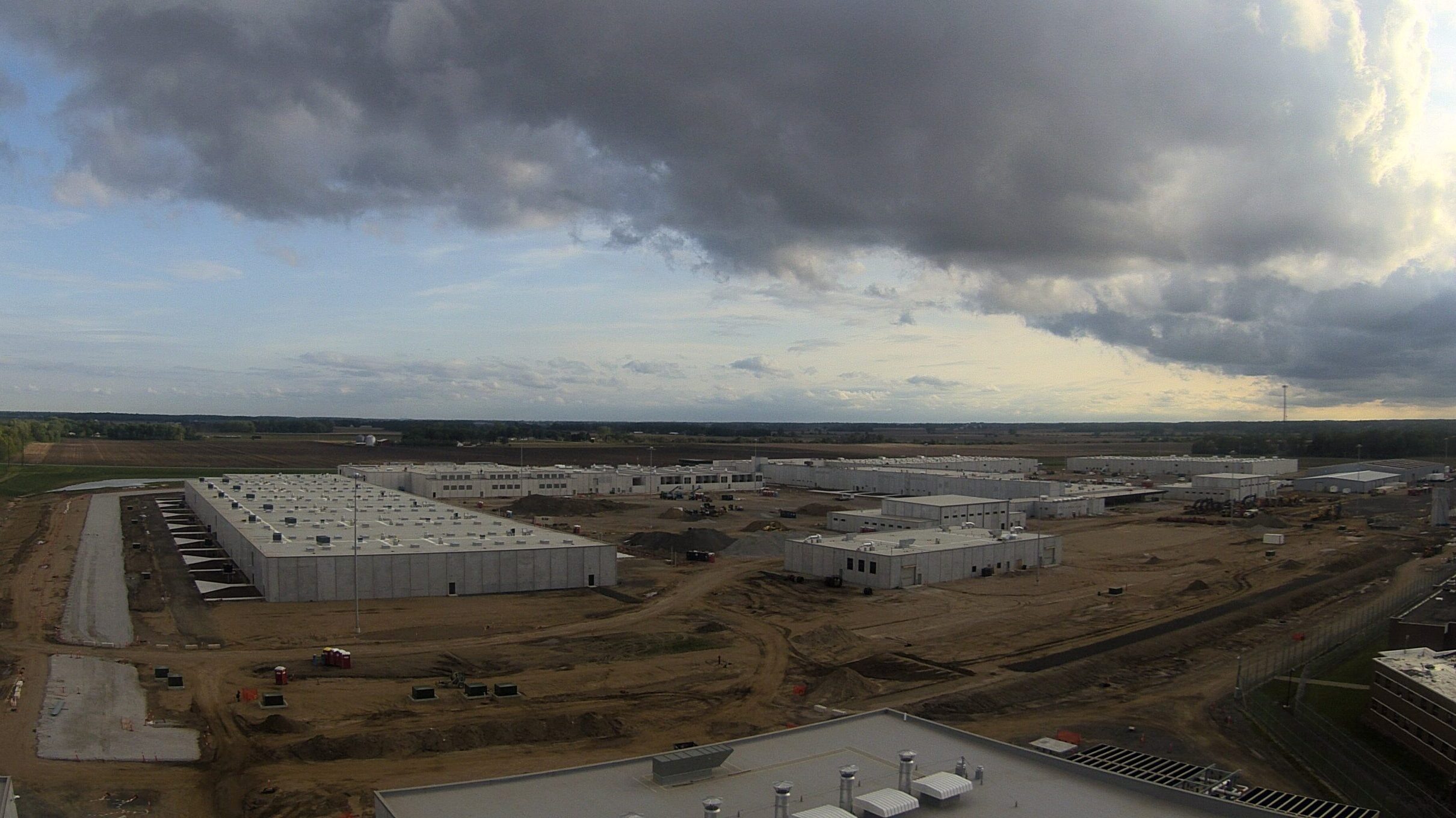
The new Westville State Prison is expected to open in 2027. The campus will feature steel modular cells, state-of-the-art security electronics and an efficient central utility plant. | Photo Credit (all): IDOC
By Dena Sattler
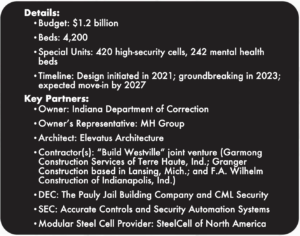
A $1.2 billion project spanning 1.4 million square feet, the new Westville State Prison (WSP) is the most ambitious state building project ever in Indiana. Funded entirely by cash reserves to avoid borrowing, WSP is set to open in early 2027 — on time and on budget.
“We’re immensely proud of the partnerships that have made this possible,” Indiana Department of Correction (IDOC) Commissioner Lloyd Arnold said. “Westville is a state-of-the-art facility designed to meet the needs of Indiana’s incarcerated individuals — all with the goal of reducing recidivism.”
IDOC data shows 36.52% of offenders were recommitted within three years. Most had substance abuse problems.
“The need for addiction recovery services across the incarcerated population is clear,” Arnold said. “Westville State Prison is designed to meet that need, with 240 beds dedicated to incarcerated individuals battling mental health or addiction issues. This is one of the most important steps we can take in reducing recidivism — making sure people have access to the treatment they need before release.”
The massive new facility is designed to ease overcrowding, and provide educational, vocational, and life skills needed to reduce recidivism — all with an emphasis on rehabilitation.
Maximum-security space is needed in the corrections system. IDOC reported its male maximum-security facilities at more than 90 percent occupied since at least 2019, with 95 percent operating just below full capacity.
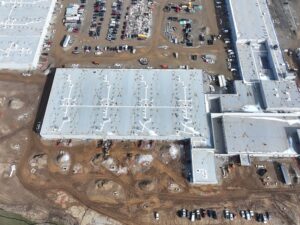
Initial plans for the new, larger prison called for both the outdated Indiana State Prison in Michigan City, Ind., and current, 1950s-era Westville Correctional Facility property to be shuttered. But with a rising prison population due to recent policy changes, IDOC now plans to keep using Indiana State Prison with nearly 2,500 beds for an undetermined length of time after the opening of the new facility, which will have 4,200 beds.
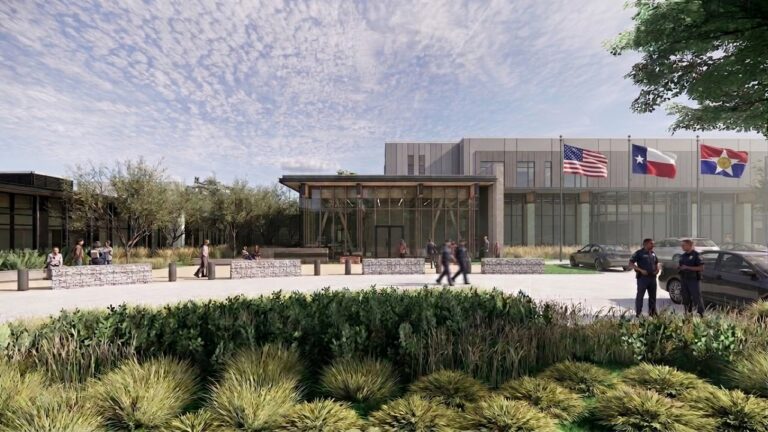
The new campus layout of 28 buildings over roughly 90 acres for incarcerated individuals’ housing, administrative space, program and vocational training areas, medical and mental-health facilities, security operations, food services, recreation and support also was designed to lessen recidivism.
IDOC data from 2024 shows of those offenders released in 2021, 36.52% were recommitted to the IDOC within three years. Most, by far, had substance abuse problems. According to IDOC, 80% of the incarcerated population needs access to mental health and/or addiction recovery services.
With that in mind, Keith Ivkovich — Senior Project Manager with Granger Construction and Project Director for the new Westville State Prison — said the Mental Health Wellness Addition will provide tailored, comprehensive programming through new and redesigned space, with 240 beds dedicated to mental health and addiction recovery; a step-down treatment unit; and a holistic environmental design that includes sound-dampening dayrooms to reduce agitation.
“You just look nationally — there’s a serious mental health crisis in the United States. It’s even more prevalent in the corrections industry, as corrections now has been historically being used as almost the rehabilitation service that the states offer,” Ivkovich said, adding the goal is “having facilities that can actually treat offenders, get them the help they need, and step them down so that as they get out of the system they’ve dealt with those issues.”
The design by Elevatus Architecture emphasized streamlined movement of incarcerated individuals, better staff sightlines and improved oversight. For example, no building is higher than two stories to reduce operational challenges and enhance security.
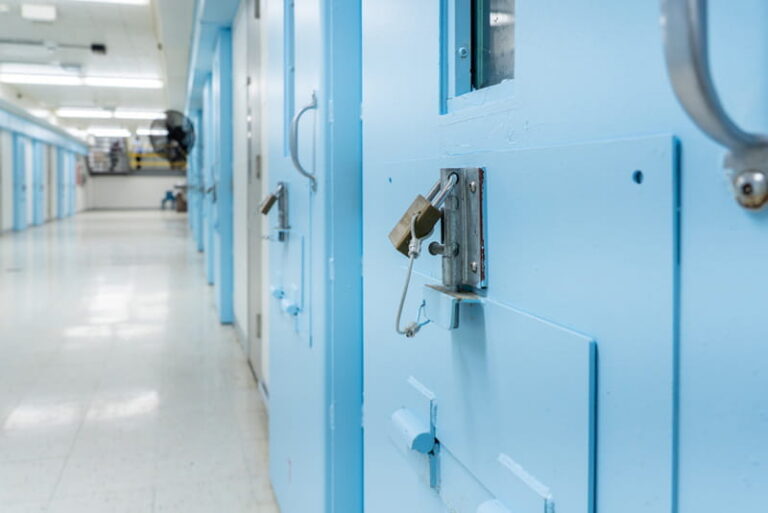
“With incarcerated individual movement, those are all things that correctional officers can be a little nervous about. It puts everybody at a little bit of a risk,” Craig Armstrong, Lead Architect, Partner and Department Leader at Elevatus, said. “Considering that in our design — how people maneuver and move through spaces — was kind of a challenge in something this large because so many services are offered in different buildings in different parts of the campus.” Other safety-minded details include central security stations so no officer works alone, and the ability to secure units individually as needed. Modern steel modular cells manufactured by SteelCell of North America, state-of-the-art security electronics and a highly efficient central utility plant support multiple buildings across the campus.
Developing a Unified Approach
The massive project known as “Build Westville” has combined the strengths of three core contractors: Garmong Construction Services, Granger Construction and F.A. Wilhelm Construction. Along with Elevatus Architecture and ancillary firms, they function as one team.
“We share a similar vision of how we wanted this project to be executed,” Ivkovich said. “That’s really the key to our success, that when we go shields up, we’re not going shields up against each other. We’re going shields up against the problem as a collective group.”
 Company logos are scarce on a work site where employees instead wear gear emblazoned with the “Build Westville” brand. “It’s not that we’re embarrassed of where we come from,” Ivkovich said. “We wanted to become one group. So [Build Westville] is really our ethos.”
Armstrong echoed the sentiment. “It starts at the onset,” he said. “You build and establish a layer of trust with all of the team members early, and then the project goes a lot smoother.”
Ivkovich notes there’s always room for improvement. One lesson learned, he said, was that connectivity could have been “a little more cohesive.”
“If we were to go back and do it again, it would be sort of how we interface the connections from the central utility plant into the buildings, making sure that the individual buildings know when they’re going to be getting their power,” he said. “It hasn’t been damaging to the project, but it could have been more seamless.”
The new campus developing alongside the current facility does have plenty for other states looking at new prisons to consider.
“Westville State Prison is setting the standard for what is possible in corrections,” Arnold said. “We are confident that corrections professionals nationwide will be looking to Indiana as they determine how to meet the needs of their own incarcerated populations.”
“We do feel that the model that we have implemented here at this particular facility certainly has its advantages,” Armstrong said. “It all comes down to the operations, the specific operations at the specific facilities on how they want their buildings and project organized.”
For other states considering a comparable venture, Ivkovich said: “This is not a one-off, what we’re accomplishing here. This can be scaled and reproduced for any size project that’s coming up in the future. I think that’s important to note because there’s so many projects that just linger in the news about ‘years overdue’ and millions and millions and millions of dollars over budget, you know, or a facility’s not getting the operational things that they need — so it’s important that they know that this can be reproduced.”
Editor’s Note: This article was originally published in the 2026 Maintenance & Operations edition of Correctional News. An earlier version of this article incorrectly identified the project as the Northwest Indiana Correctional Facility and excluded comments provided by IDOC and members of the project team. It also incorrectly listed the cell type as precast modular. The cells were steel modular cells provided by SteelCell of North America. The corrected article was republished on July 1. Correctional News regrets the errors.