




Rethinking Women and Special Populations in Corrections
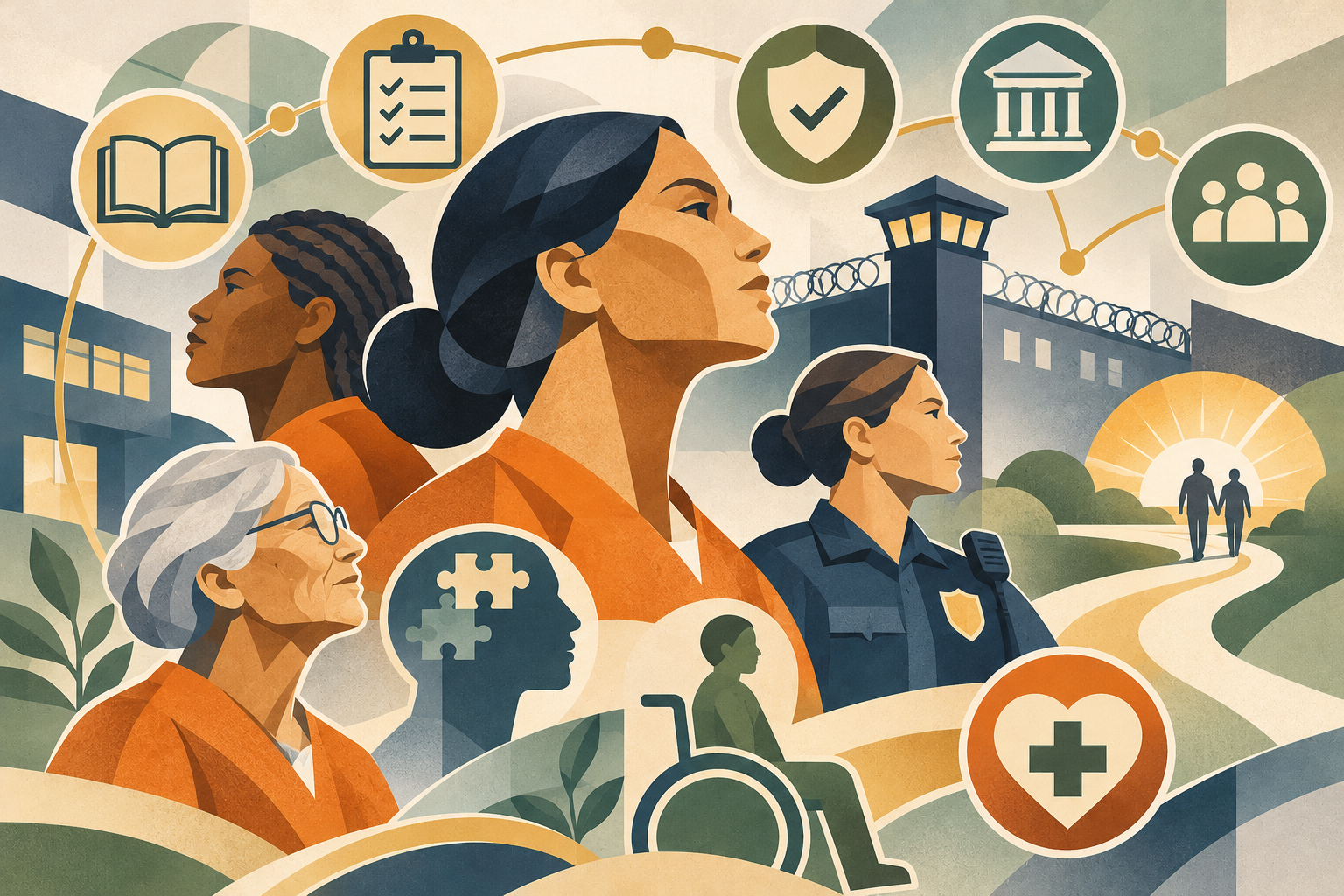
Correctional agencies can align policy, staffing, training and daily practice to address changing population needs. | Photo Credit: Generated with OpenAI (ChatGPT)
By Ken Hyle
For correctional leaders, incarcerated women and special populations are not a niche issue; they are an operational, fiscal, legal and workforce priority. Individuals requiring adapted supervision, behavioral-health support, disability accommodations, aging-related services or population-specific practices often drive some of a system’s most complex decisions. Without clear policies and practices in place, agencies face safety risks, staff uncertainty, litigation exposure, medical costs and operational disruption.
The data is compelling. A recent Council on Criminal Justice analysis projects that the number of women in custody will reach 1.1 million by 2035, with the female prison population increasing 27% and the female jail population increasing 20%. The analysis also projects that annual costs for women’s justice-system involvement will rise about 34%, from between $23 billion and $26 billion in 2025, to between $30 billion and $34 billion by 2035.
 The aging population is also creating pressure. The Bureau of Justice Statistics reported that from 2020 to 2023, the number of people age 65 and older in jails grew 78%. The Prison Policy Initiative reported that people age 55 and older grew from 3% of the prison population in 1991 to 15% in 2021. Older adults often require more medical care, mobility support, disability accommodations, specialized housing, end-of-life planning and reentry coordination.
Effective special-population management begins with an accurate picture of agency strengths and opportunities. For more than two decades, The Moss Group (TMG) has provided these insights, supporting correctional agencies when the work is complex, the stakes are high and solutions must withstand real-world operations. The company’s model is straightforward and effective: practitioners helping practitioners.
TMG’s mission is to create cultures of safety with partners, producing positive outcomes for staff and the populations served. With projects completed in all 50 states, TMG works across prisons, jails, community corrections, probation and parole, youth justice and other 24/7 operations. The firm provides expertise and services on security and operations, special populations, leadership and culture, sexual safety and PREA, workforce development and litigation support.
TMG has completed more than 300 facility assessments, giving leaders data, information and realistic recommendations. TMG has also developed a staffing analysis protocol to support effective staff deployment based on current resources and the operational needs of special population management.
Case Study: Strengthening Safety and Practice with Incarcerated Women
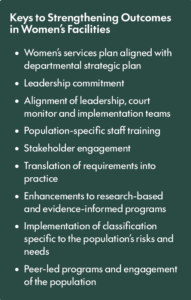
Women’s facilities have been the subject of significant litigation, investigations and consent decrees involving sexual safety. The risk is not simply the number of lawsuits; it is the concentration and complexity of issues that can arise in women’s facilities. One of the most difficult challenges a correctional agency can face is rebuilding safety, trust and operational confidence while under a judicial consent decree.
TMG is often called to support agencies facing these complex challenges, working with leaders who are interested in more than compliance to strengthen facility culture and safety. This work is rarely limited to one policy, one training or one operational fix. Meaningful progress often requires looking across the entire system: how staff are trained, how expectations are communicated, how concerns are reported and addressed, how programs support the population and how daily decisions reinforce safety. TMG helps agencies create a model of best practices in engaging executives, external stakeholders, facility leaders, frontline staff and the population — resulting in expedited compliance and anchoring for continuity of success.
Case Study: Aging Population
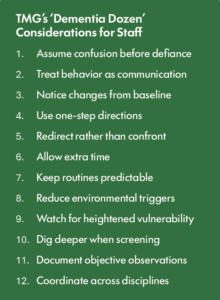 As the correctional population ages, agencies are increasingly managing dementia and cognitive decline in environments not designed as care settings. Staff may see missed movement, repeated questions, hygiene decline, confusion, wandering, agitation, or rule violations and interpret them as defiance or misconduct, when they may reflect cognitive impairment. The challenge is to maintain safety and security while helping staff recognize when behavior requires a different response.
TMG translates clinical concepts into practical training and tools for non-clinical staff. Staff are trained to recognize changes, respond safely and document objectively.
The result is a more coordinated and defensible response to aging and cognitively impaired individuals in custody. Agencies gain practical strategies uniting custody and clinical teams, and leaders are better positioned to align housing, classification, supervision and care.
Final Thoughts
At its best, special-population work strengthens the entire correctional environment. When staff understand the population, boundaries are clearer. When housing and supervision decisions are individualized and well-documented, risk is reduced. When leadership aligns policy with practice, staff receive consistent direction. When training is practical, staff confidence improves. When people in custody experience safety, dignity and respect, facilities reduce operational disruption. Regardless of the need or population, TMG’s goals remain constant: every staff member goes home safe each day, and every incarcerated individual has meaningful opportunities for growth.
TMG Enters Its 2.0 Era
After more than two decades of leadership, founder Andie Moss has stepped into the role of Chief Executive Officer, continuing to guide TMG’s impact across the field. Mara Dodson, Vice President of Strategy and Growth, now serves as President. This transition positions TMG for a strong and exciting future, strengthening its ability to grow, serve and deepen contributions to public safety.
Ken Hyle is Vice President of Correctional Services for The Moss Group. This article was sponsored by The Moss Group. To learn more, visit www.mossgroup.us.
This article was originally published in the 2026 Healthcare edition of Correctional News.