




Building for Wellness in Westville
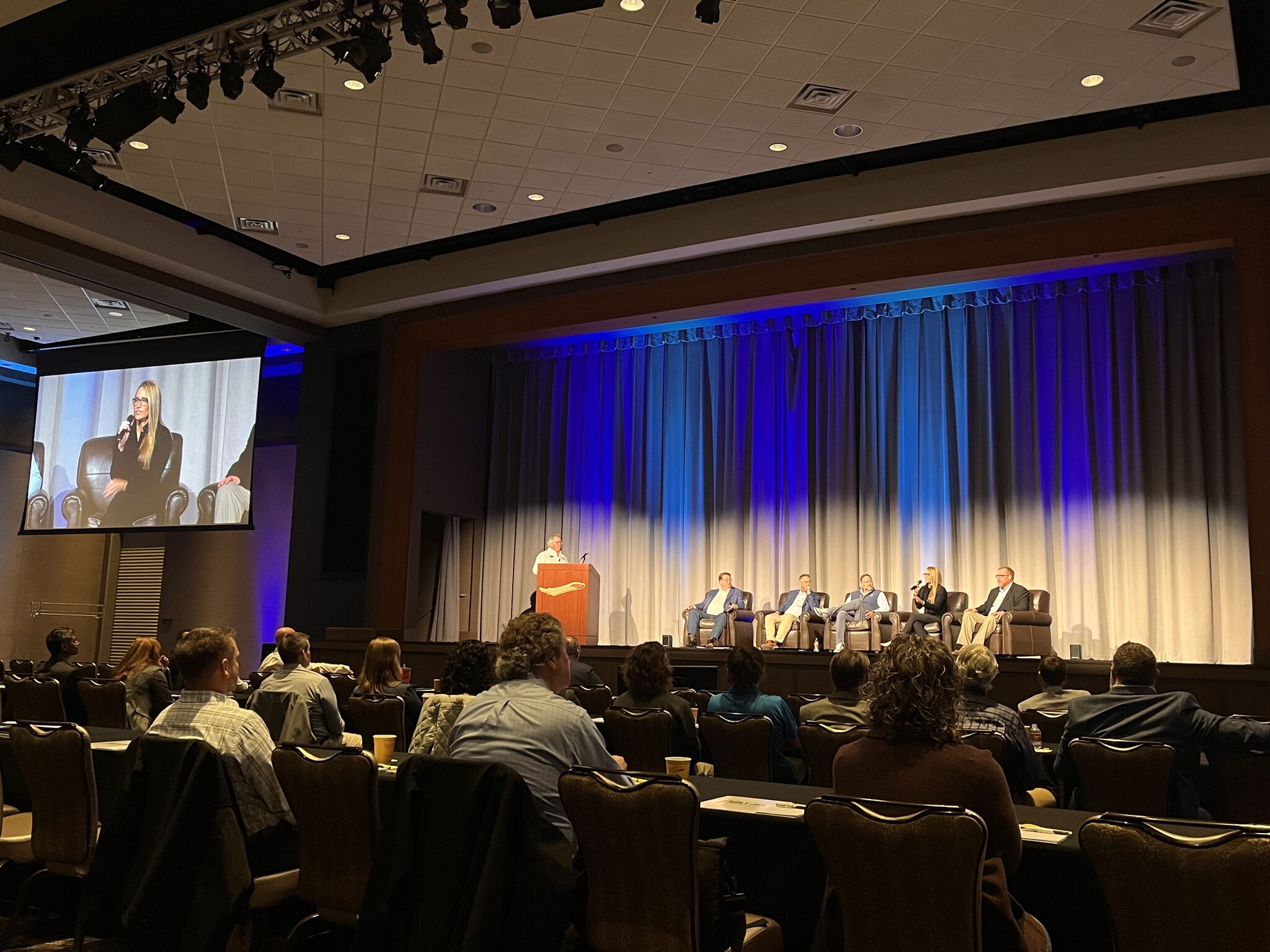
Photo: Joe Pohrer, President of Pauly Jail Building Co., moderated a design-build panel, featuring Henry Painter, Gilbane Building Company; Rick Bruining, BELL Construction; Paul Okeson, Garmong Construction Services; Leanne Skuse, River City Construction; and Rob Train, Granger Construction. | Photo Credit: Correctional News
By Charlie Lange
Throughout history, seemingly unconnected events have produced unintended consequences that have had generational effects.
For example, in the United States, the deinstitutionalization movement that began in the 1960s (and saw the closing of mental health facilities throughout the country over the ensuing decades) resulted in a strain on the rest of the traditional healthcare system as well as the country’s various social safety nets. Deinstitutionalization also caused many people experiencing the most severe mental health issues or substance use-related crises to slip through the cracks and become involved in the criminal justice system.
In the ensuing years, jail and prison operators have found themselves on the front lines of providing medical and mental healthcare services to address the many — and often chronically untreated — needs of the incarcerated community. The responsibility of delivering services that were previously provided in specialized mental health hospitals has now fallen on correctional providers. Those in charge of upgrading and/or replacing correctional facilities are responding by designing jails and prisons that can address these issues directly and comprehensively.
The Northwest Indiana Correctional Facility, currently under construction in Westville, Ind., isn’t just the latest example of such a facility, but is perhaps the largest in scope as well. Once complete, the $1.2 billion, 4,200-bed facility will be one of the largest correctional facilities ever built in the U.S.
In October, Pauly Jail Building Company hosted a tour of the facility, followed by a seminar highlighting the partnership that was formed to complete this massive project. The company outlined how mental health and medical needs will be uniquely addressed throughout the 14-building campus, which is set for completion in fall 2026.
“Touring the active construction site and witnessing the progress and innovations being made in such a short time was truly remarkable and is testimony to the remarkable team the State of Indiana has assembled to build a facility of this magnitude,” said Jared Bailey, Vice President of Pauly Jail Building Company.
Embracing Environmental Psychology
During the seminar, Deanna Dwenger, Psy.D., HSPP, Chief Behavioral Health Advisor for Elevatus Architecture, the design firm behind the new Westville facility, outlined some of the general design concepts that go into establishing places for healing and rehabilitation, and how those elements have been carefully incorporated throughout the new Westville facility.
Dwenger leads the firm’s efforts to integrate mental health expertise into the design process and helps to ensure that environments prioritize psychological wellbeing and human connection. Dwenger’s work is backed by years of operations experience, as she previously served as the Executive Director of Behavioral Health for the Indiana Department of Correction as well as Director of Behavioral Health at Wexford Health.
Dwenger discussed how environments can impact behaviors and how anxiety and trauma can manifest in a correctional setting, leading to aggression and other negative behaviors.
“It’s about using research and environmental psychology to do the best that we can to help people self-regulate their emotions, heal and re-enter our society,” said Dwenger.
She cited examples of how small details, such as the incorporation of soothing colors, biophilic design elements, natural light sources and sound-dampening materials can contribute to a decrease in aggressive behavior.
Dwenger also highlighted the need to give incarcerated individuals some level of autonomy in their everyday lives. That could include allowing more customizable cell layouts with normative furniture and fixtures, installing dimmable lights, or introducing chalkboard walls. Dwenger says that giving incarcerated individuals small choices can inspire a greater sense of agency and can contribute to a safer, calmer and more controlled environment.
Designing the Details
In line with Dwenger’s environmental approach, the Westville design team has attempted to address mental health needs holistically, from overarching conceptual design themes to smaller details.
In the general-population dayrooms, for example, colorful acoustic panels have been installed on walls and ceilings alongside sound-dampening features to reduce noise, which can increase stress and agitation.
To learn more about the Westville facility’s step-down unit for mental health treatment, as well as its other broader health-focused design elements, read the rest of the article in the November-December 2025 Healthcare edition of Correctional News.