



New Behavioral Health Unit Opens at Shawnee County Jail
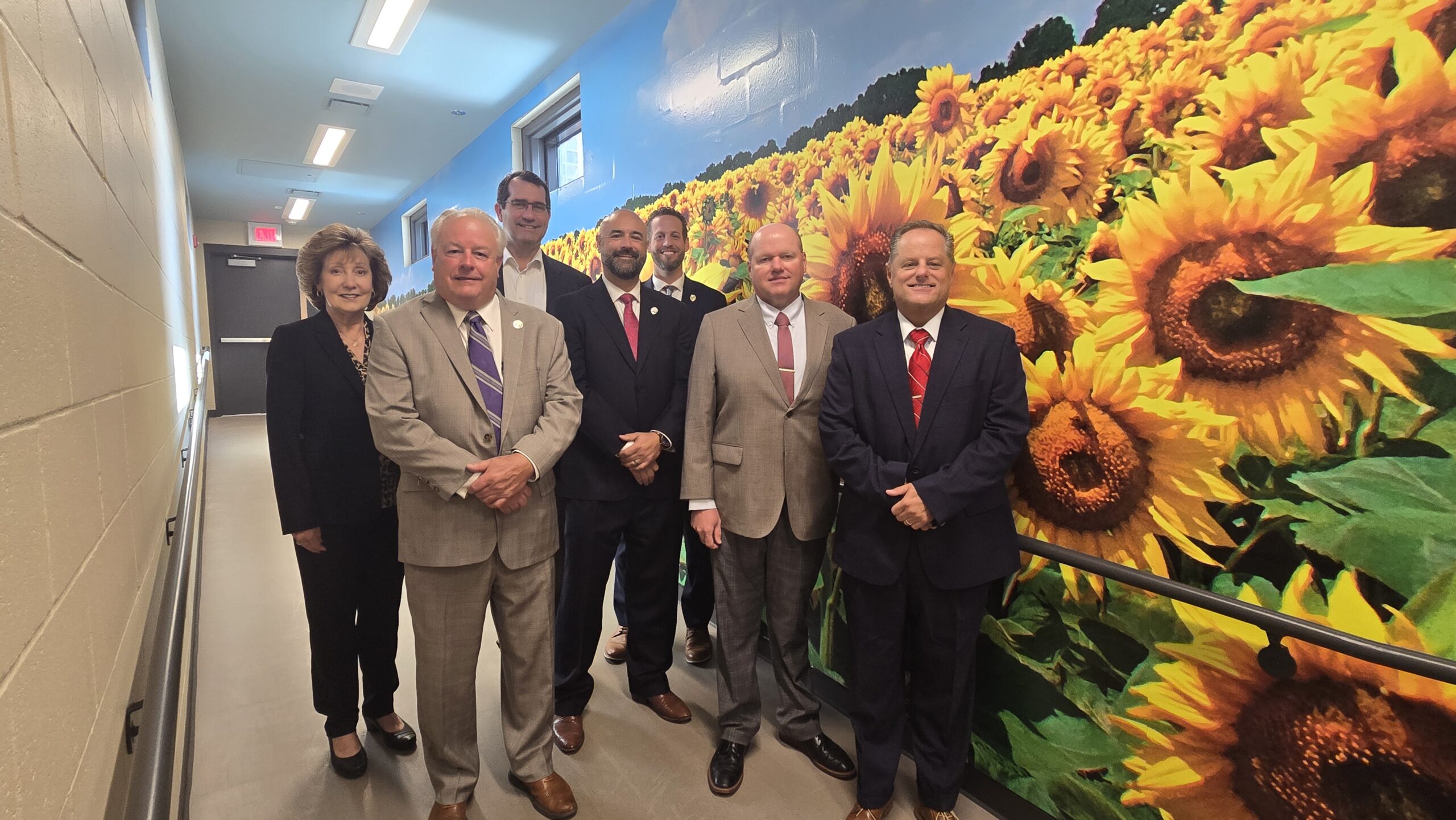
The new Behavioral Health Unit at the Shawnee County Jail in Kansas will provide mental health stabilization services for up to 60 inmates awaiting trial. Pictured, from left: State Senator Brenda Dietrich, Shawnee County Commission Chair William Riphahn, U.S. Congressman Derek Schmidt, Shawnee County Commissioner Aaron Mays, Shawnee County District Attorney Mike Kagay, Shawnee County Commission Vice Chair Kevin Cook, and Shawnee County Department of Corrections Director Brian Cole. | Photo Credit: Shawnee County Department of Corrections
By Charlie Lange
- Shawnee County, Kan., opened a 60-bed behavioral health housing unit at its jail in Topeka on Aug. 24.
- The $21 million unit is designed for inmates awaiting trial who need mental health, substance-use, suicide-prevention or competency-related services.
- The opening concludes three years of planning, design and construction involving HTK Architects, HDR and KBS Constructors.
TOPEKA – Officials in Shawnee County, Kan., have opened a new 60-bed Behavioral Health Unit at the Shawnee County Jail in Topeka, creating dedicated space for individuals awaiting trial who need intensive mental health and substance-use services. A grand opening ceremony was held Aug. 24 after a three-year planning, design and construction process.
The $21 million addition is intended to move eligible inmates from conventional housing into a setting where they can receive medication support, suicide-prevention services, competency assistance and other specialized care. Officials described the 23,279-square-foot unit as a change in how the county manages a jail population with significant behavioral health needs.
Tim Phelps, Deputy Director with the Shawnee County Department of Corrections, told Correctional News that the facility will operate on three distinct pathways, each with their own programmatic focus.
The first will center on a program intervention-focused approach to suicide prevention, where inmates will be housed in fully appointed cells and have access to eight hours of daily programming, including art and music therapy, low-impact physical activities such as yoga, cognitive programming, group counseling and medication compliance work as needed. Combined with individual group counseling with a Qualified Behavioral Health Professional and a 1-to-10 staff-to-inmate ratio, Phelps said this pathway will increase direct engagement and significantly reduce the amount of time inmates may spend on suicide watch status.
The unit also includes programming for individuals appointed by the local court to complete competency restoration. Program participants will be brought into a single living unit, enabling a synchronization of housing and programming, which Phelps said will help improve recovery rates.
Finally, Phelps said the most acute inmates suffering from serious and persistent mental illness will be housed separately and offered programming similar to suicide-watch-status inmates, but with additional education to help them cope with their mental illness successfully in the community. This pathway will also offer a more intensive tablet-based education programming system.
Phelps said that representatives from every component of the agency were involved early in the design process to help guide the facility’s flow and functionality. New features of the facility designed by HTK Architects and HDR and built by Topeka-based KBS Constructors include a therapeutic seven-color palette, adjustable lighting, residential-style exterior windows to bring in natural light, sound baffling, and shower doors that lock against outside intrusion but allow inmates in crisis to release themselves from the inside. Each unit will also come equipped with a safety room and softer, normative furniture in cells and day rooms.
The project included CareAffirm modular cells provided by SteelCell of North America, as well as hollow metal doors and frames, ceilings and wall panels from Titan Steel Door, installed by Pauly Jail Building Company.
Phelps noted that mental and behavioral health issues within incarcerated populations are a challenge across all of corrections, and said he hopes the facility can serve as a model for other agencies looking for solutions.
“We have a strong vision on how to build a national model, and it is our hope that we can see this approach built into mid-size and large jails throughout the country,” said Phelps. “Nobody has the one plan that works everywhere. But unless we pour ourselves into finding creative and concrete solutions, we are not serving our communities like we should. It is about changing the paradigm to meet the changing reality.”