




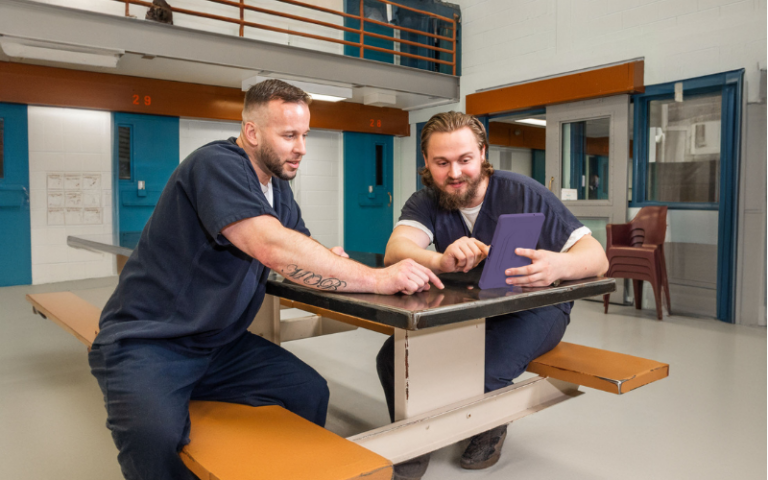
Collaborative Model Reshapes Safety Behind Correctional Walls
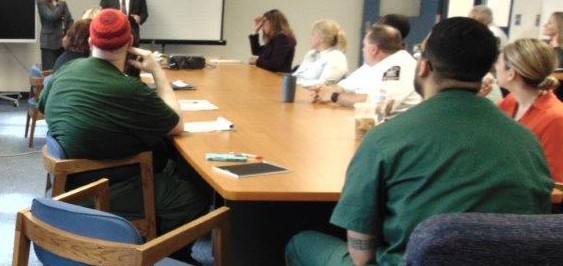
Facility leaders, security and non-security frontline staff and people incarcerated meeting to discuss wellness and safety issues in a New York correctional facility. | Photo Credit (all): Chicago Beyond
By Matt Burke
“That’s the way we’ve always done it.”
These are the most dangerous words in the field when it comes to improving safety and wellness for everyone behind correctional walls. For correctional leaders, challenging the status quo is rarely easy. Leaders face legitimate concerns around staffing shortages, aging facilities, limited resources, public scrutiny and competing operational demands. Friction is inevitable. The question is not whether leaders will encounter it, but whether they have practical and effective ways to navigate that friction while improving safety and wellness for everyone inside their facilities. One approach that can help leaders do that is collaborative engagement.
Understanding Collaborative Engagement
Collaborative engagement is a structured process that brings correctional leaders, frontline staff and people who are incarcerated together to identify shared challenges, develop practical solutions and continuously improve the conditions that shape safety and wellness. Rather than relying solely on top-down decision making, it creates regular opportunities for the people closest to the work and daily operations of a facility to solve problems together.
Across nine correctional systems Chicago Beyond has worked with to implement the Holistic Safety Framework, collaborative engagement has been implemented to varying degrees. This approach has been associated with reductions of up to 50% in serious incidents, including assaults on staff and uses of force, while also improving institutional culture and advancing meaningful policy reforms.
Chicago Beyond’s Holistic Safety Framework
By bringing together the people who know correctional facilities best, collaborative engagement offers one practical way forward to address conditions affecting wellness and safety. This approach recognizes that safety and wellness are interconnected and cannot be improved in isolation. It recognizes that lasting improvements cannot be achieved through policy alone, nor can they be solved from a single point of view.
As one correctional union leader explained, “In the past, there have been siloed efforts around care, wellness and safety. But if you leave one part out, it is like changing one tire on a car when all four tires are flat.”
Rather than prescribing one-size-fits-all solutions, the Holistic Safety Framework and Change Management Toolkit help correctional systems examine the physical, emotional, relational and operational conditions that influence daily life inside facilities. It then creates structured opportunities for leaders, staff and people who are incarcerated to identify challenges together, test solutions, learn from one another and adapt over time.
Collaborative engagement can initially feel uncomfortable because it challenges traditional assumptions about who should help solve problems. Yet that discomfort often becomes the foundation for meaningful change.
“At first, I thought this was just another thing we had to do,” one correctional employee reflected. “But as I began to hear what was being surfaced and the common ground we all had, and as I saw how everyone started to relate and respond to one another more positively, I realized it was needed now more than ever.”
Moving Beyond ‘Us vs. Them’
One of the earliest changes collaborative engagement produces is not related to policy; it is a shift in relationships. As one person who is incarcerated explained, “It bridges the gap between us and them, so it’s … just us working together to try to get to a positive place.”
An assistant warden described a similar transformation: “The traditional way was always us against them. In corrections, you are taught not to show vulnerability or emotion. For people incarcerated, it was either following the rules or be disciplined. It wasn’t a healthy system. But learning this different way — including both sides and getting feedback from both sides — is really powerful.”
These conversations create the trust necessary to generate practical solutions to issues that may otherwise go unaddressed. Correctional systems often identify immediate opportunities to improve wellness and safety through relatively simple changes. Leaders have described these as the “low-hanging fruit.” Examples include:
- Modernizing staff gyms and wellness spaces
- Making common-sense changes to uniform policies for people incarcerated
- Expanding recreation and programming opportunities
While these early improvements may appear modest, they serve an important purpose. They build further trust, agency and momentum, making it possible to pursue larger, more sustainable reforms. Across systems, collaborative engagement has led to the creation of full-time staff wellness teams, revisions to disciplinary and restrictive housing practices that reduce crowding and create more rehabilitative environments, and improvements to visitation policies, spaces and procedures.
Taken together, these changes demonstrate that collaborative engagement is not simply about generating ideas. It creates the conditions necessary for meaningful organizational change. Over time, these conditions contribute to safer, healthier facilities for everyone.
Moving Forward
Correctional leaders do not need more evidence that the status quo is failing people who live and work inside correctional facilities or the communities to which they return. They need practical strategies that help them lead meaningful change.
Collaborative engagement does not eliminate friction or suggest that leaders must give up authority. Rather, it provides leaders with a disciplined structure for drawing upon the experience and expertise of the people who understand correctional environments most intensely.
As one correctional leader admitted, “We often feel like we know what is best because that is what we are taught. But if you listen to staff and people incarcerated, they can tell you what can create change, because they deal with it every day.”
The safety and wellness within prisons and jails will not depend solely on new policies or programs but on correctional leaders committed to creating environments where frontline staff, people incarcerated and facility leadership work together to solve problems. If systems want safer facilities, better working conditions and better outcomes, the people closest to the work must help build them.
Matt Burke is the Director of Justice Initiatives for Chicago Beyond.
This article was originally published in the 2026 Healthcare edition of Correctional News.