



Creating More Pathways to Postsecondary Success in Corrections
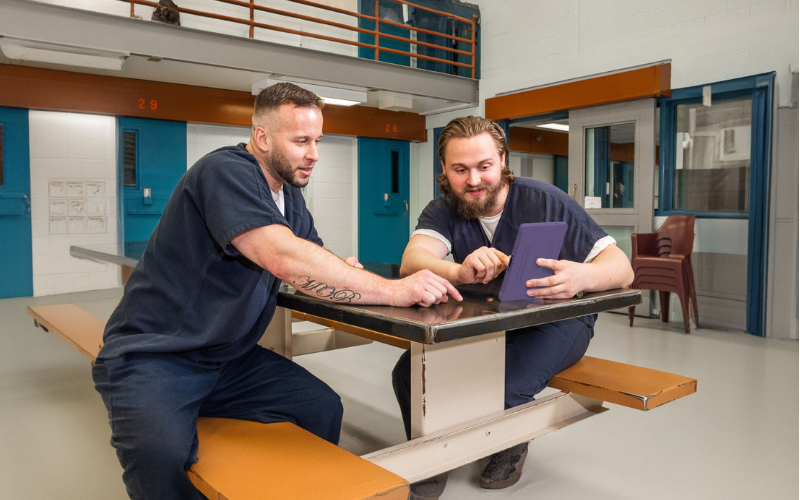
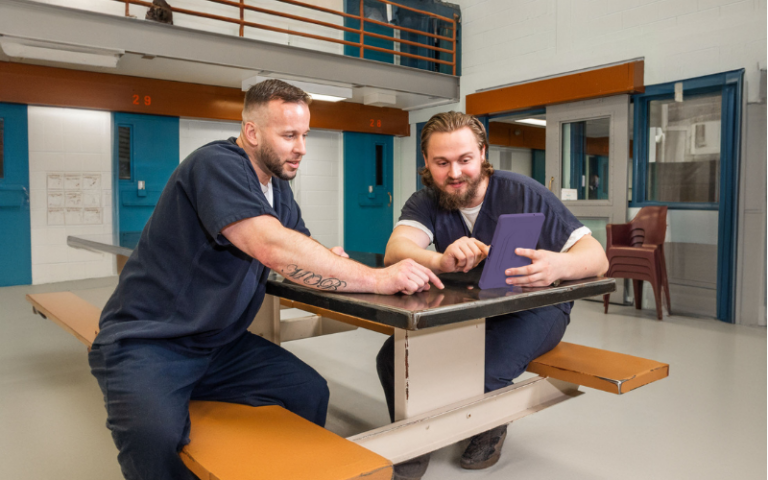
Digital learning tools are expanding access to postsecondary education in correctional facilities, allowing incarcerated learners to build academic skills, prepare for college-level coursework and pursue educational opportunities beyond traditional classroom settings. | Photo Credit: Securus Technologies
By Jamie Newberry, Anna DeLuna Ferguson and Dannielle Doyle
We solved one of education’s biggest challenges during COVID: how to reach students who couldn’t be in a classroom. Why should correctional education be any different?
The rapid expansion of digital learning proved that geography does not have to dictate educational opportunity. Today, in correctional settings, access to postsecondary education often remains constrained by physical capacity, staffing and logistics.
With Prison Education Programs growing and Pell Grant access restored, the next frontier extends beyond expanding educational offerings. It’s about ensuring those opportunities reach more incarcerated learners at scale.
While the solution at hand rests in education, the broader opportunity is to reshape public safety and workforce opportunity. Consider the scale: 82% of formerly incarcerated individuals return to incarceration within 10 years. However, individuals who participate in correctional education programs are 43% less likely to recidivate, shifting the question from “whether education matters,” to “how we achieve scaled access.”
If we believe that access to education improves outcomes, then scaling availability also requires solving a fundamental capacity challenge. Most correctional systems cannot build classrooms, hire instructors or expand Prison Education Programs quickly enough to meet learner demand. That’s where technology is changing the equation.
Educational technology is helping agencies extend learning beyond traditional systems and limitations like enrollment and classroom space. Technology multiplies the reach of educators and their support systems, creating more opportunities for learners to prepare, persist and succeed.
Expanding Access Beyond the Classroom
The best examples are not about technology for its own sake. They’re about expanding capacity. Through platforms like Edovo, learners can access no-cost educational content, including Modern States courses that prepare them for College-Level Examination Program (CLEP) exams and potential college credit. Rather than waiting months for a classroom seat to open, learners can begin preparing immediately. This reflects a broader shift in correctional education: learning is no longer confined to scheduled class time or available seats. Technology allows learners to progress when they are ready to engage, helping institutions extend opportunity beyond the physical limits of the classroom.
Chad, an incarcerated learner in Arizona, said this about having access to college-level courses: “…It has by far been my favorite course on Edovo. It contains excellent content and was challenging and this type of course truly is life-changing for incarcerated individuals. It can provide [them with] skills that are hard to come by for any individual.”
For correctional education leaders, there is an opportunity to look beyond individual tools and consider how existing resources can work together to create a more intentional and connected learning pathway. Many facilities already have educational content available through secure technology. The next step is to intentionally integrate those resources into broader academic planning so learners can begin preparing before they enter a formal college classroom.
Rethinking College Readiness
One of the biggest opportunities may be expanding who we consider a future college student. Some of the most overlooked learners are those without a high school diploma or high school equivalency credential, such as the GED or HiSET, and thus assumed to be ineligible for Pell-funded college programs.
However, the Higher Education Act provision known as Ability to Benefit provides a pathway for eligible students without a high school diploma or high school equivalency credential to qualify for federal student aid by demonstrating college readiness through an approved assessment and meeting other program requirements.
The ACCUPLACER exam is one approved measure of college readiness, and Essential Education helps correctional education programs prepare learners for that next step. Through its College Essentials program, students develop the skills needed to succeed on the ACCUPLACER and, once Ability to Benefit requirements are met, may qualify for Pell-funded postsecondary education. This creates a stronger bridge between foundational learning and the postsecondary pathways that can support long-term educational and workforce success after release.
Rather than viewing college readiness as a prerequisite, agencies can view it as something they actively develop. Essential Education helps learners build foundational skills, earn a high school equivalency credential and prepare for postsecondary education. The result is a larger pipeline of college-ready learners and more opportunities to access education that can support long-term success.
But expanding the pool of college-ready and eligible learners also increases the need for programs capable of serving them. That makes the next challenge one of capacity: how agencies use available funding, partnerships and infrastructure to create enough pathways for learners to continue into postsecondary education.
Investing in Access and Capacity
A decade ago, many agencies might have asked whether correctional education could be funded. Increasingly, the question is how to deploy available resources most effectively. Restored Pell Grant access, workforce-development investments and growing state support are creating new opportunities to expand postsecondary programming. For agencies, the strategic challenge is identifying investments that generate the greatest increase in learner access and success.
Expanding partnerships with colleges and universities can increase access to Pell-supported Prison Education Programs. Agencies do not need to launch systemwide initiatives overnight. Many have successfully started with smaller pilot cohorts, refined implementation and expanded based on demonstrated outcomes. As educational opportunities continue to expand, agencies have an opportunity to think strategically about where new investments will create the greatest increase in learner access.
Meeting Demand, Expanding Opportunity
The demand already exists. Across Securus-enabled tablet environments, incarcerated learners have completed more than 388,000 college credits and more than 4 million Edovo courses. Those numbers demonstrate something important: when educational content becomes more accessible, learners engage. The challenge is no longer generating interest. It’s creating enough pathways to meet it.
During COVID, educators proved that learning could continue even when students couldn’t reach a classroom. Correctional education now has an opportunity to apply that same lesson.
The future isn’t defined by how many classrooms a facility can build or how many seats a program can offer. It’s defined by how effectively agencies, educators, higher education partners and technology providers work together to expand opportunity beyond those physical limits.
It’s time to ensure that geography, scheduling constraints, and capacity no longer determine who gets the chance to learn.
Jamie Newberry, M.S.Ed., is Product Manager for Growth and Innovation’s Education, Reentry and Law Library platform at Securus Technologies.
Anna DeLuna Ferguson is the Chief of Staff at Edovo, a nonprofit that provides a digital learning platform bringing free educational, vocational and college-level coursework to incarcerated learners nationwide.
Dannielle Doyle is CEO of Essential Education, an adaptive online learning platform for adult education and workforce readiness.
This article was sponsored by Securus Technologies. For more information, visit www.securustechnologies.com.