




Scaling What Works: How Secure Infrastructure Supports Safer Jails and Stronger Reentry Outcomes
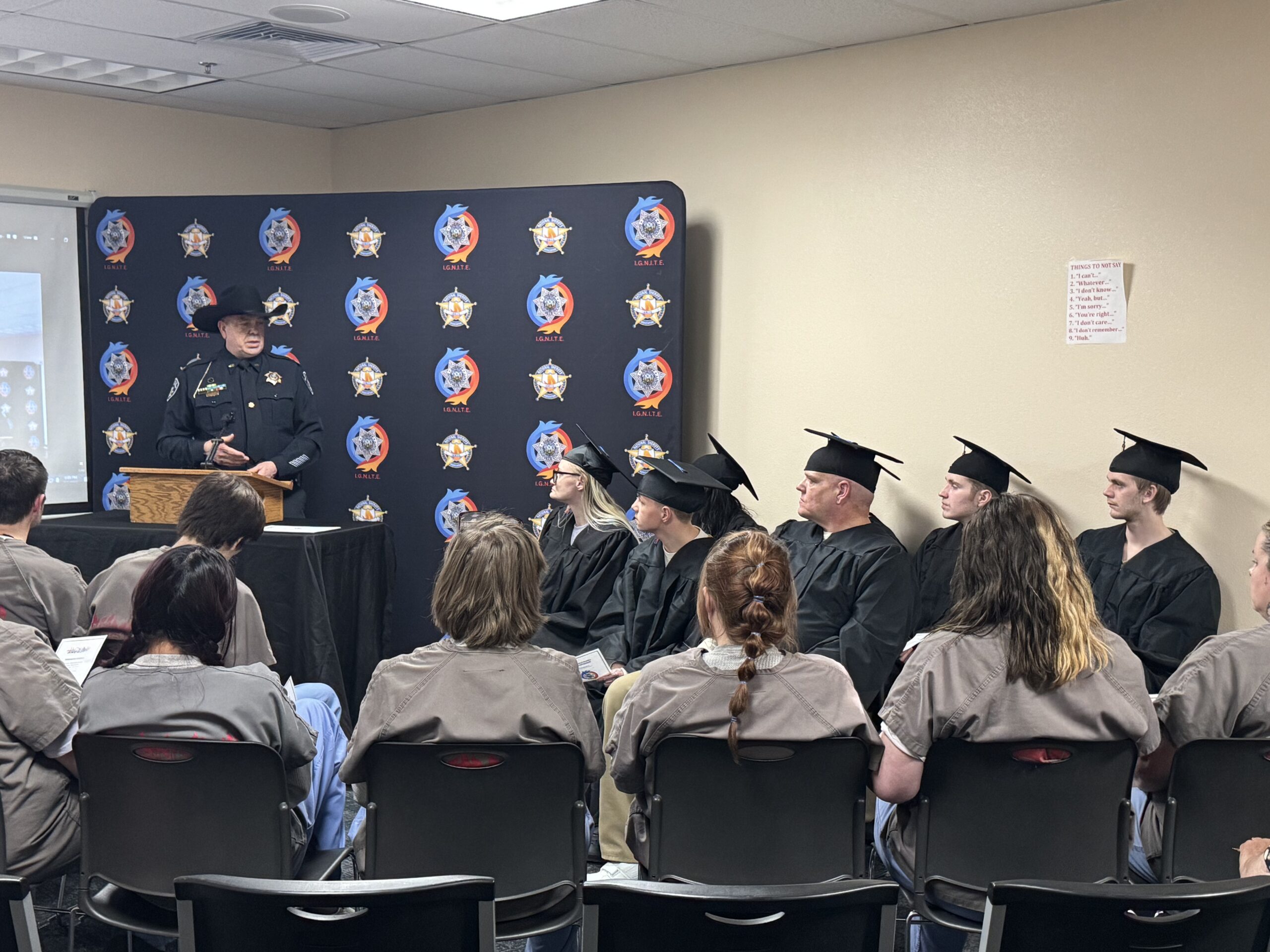
Evidence-based programming, such as the National Sheriffs’ Association’s I.G.N.I.T.E. initiative, can demonstrate how innovative, scalable infrastructure can contribute to better outcomes. This photo shows a graduation ceremony at the Bonneville County, Idaho, Sheriff’s Office. | Photo Credit (all): National Sheriffs’ Association I.G.N.I.T.E.
By Stephanie Anderson, Aventiv Technologies
Across the country, sheriffs, wardens and jail administrators are actively redefining what effective corrections looks like. Today’s leading facilities are prioritizing safety, accountability and preparation for reentry, recognizing that jails are not just places of custody, but critical environments for intervention, structure and long-term community impact.
At the center of this evolution is a growing emphasis on evidence-based programming supported by secure, purpose-built infrastructure. When technology is designed to function as core correctional infrastructure, rather than as an add-on, it enables agencies to scale what works, strengthen facility culture and deliver consistent outcomes without compromising security or control.
One model that is helping lead this shift is the National Sheriffs’ Association (NSA) I.G.N.I.T.E. initiative that demonstrates how innovation can be expanded nationally through the right operational foundation.
A Proven Model, Built to Scale
I.G.N.I.T.E. — an acronym for Inmate Growth Naturally and Intentionally Through Education — was developed by a sheriff, for sheriffs, beginning in Genesee County, Mich., and taken on as an initiative by the National Sheriffs’ Association. Today, the initiative operates in 34 facilities across 15 states, with continued interest from jurisdictions seeking to strengthen safety and reentry outcomes.
The results are measurable. Independent research shows that one month of I.G.N.I.T.E. participation drives a 25 percent reduction in weekly misconduct and a 24 percent reduction in recidivism. Additional analysis from Stanford, Harvard and Brown Universities estimates more than $7,000 in social cost savings per participant within the first year.
These outcomes reflect what correctional leaders increasingly recognize: structured education, accountability and engagement are not ancillary to facility operations; they are central to creating safer, more predictable environments for staff and individuals alike.
Infrastructure as a Force Multiplier
What distinguishes I.G.N.I.T.E.’s expansion is not only its outcomes, but how it is delivered. Scaling effective programming requires infrastructure that works seamlessly inside real correctional environments.
Through secure technology investment and digital infrastructure, Securus brings national scale, reliability and corrections-grade security to support I.G.N.I.T.E.’s growth. By integrating I.G.N.I.T.E. within Securus’ secure tablet environment and learning platforms, facilities can expand access to programming while minimizing operational disruption.
From an operational standpoint, secure digital infrastructure functions as a force multiplier. It centralizes content delivery, standardizes access across housing units and ensures that programming remains available even as populations fluctuate. Importantly, it preserves the sheriff-led nature of I.G.N.I.T.E. by enabling local customization within a secure, nationally supported framework.
Improving Facility Culture Through Structure
Sheriffs and facility leaders consistently report that the impact of I.G.N.I.T.E. extends beyond individual participants. Structured programming reduces idle time, introduces accountability into daily routines and contributes to a calmer, more predictable facility environment.
This shift has meaningful implications for staff safety and retention. When housing units operate with clearer expectations and fewer behavioral disruptions, officers are better able to focus on supervision and engagement rather than constant reactive management. Over time, this contributes to a healthier facility culture where safety, order and rehabilitation reinforce one another.
As one longtime corrections leader involved with I.G.N.I.T.E. has noted, the program changes the focus of daily operations from managing idle time to building skills and accountability. That shift is critical for agencies navigating both staffing challenges and public expectations around rehabilitation.
Leadership Through Workforce Systems
As I.G.N.I.T.E. continues to grow, long-term sustainability depends on strong governance and a holistic view of workforce systems. Fair chance hiring, staff development and reentry preparation are interconnected, and addressing them effectively requires alignment across people, processes and technology.
My appointment to the NSA I.G.N.I.T.E. Advisory Board reflects this systems-based approach. By bringing workforce strategy, organizational design and operational insight to the table, the goal is to support sheriffs as they scale programs responsibly while maintaining local leadership and accountability.
This work is about more than individual initiatives; it is about building correctional environments that support consistent outcomes over time.
Designing the Next Generation of Corrections
For jail administrators, wardens, facility managers and state procurement leaders, the lesson from I.G.N.I.T.E. is clear: the future of corrections is being actively built today by agencies willing to invest in secure, scalable infrastructure that supports proven programming.
 When technology functions as core infrastructure, meaning integrated, durable and designed for correctional realities, it allows agencies to lead with confidence. The result is safer facilities, stronger reentry outcomes and long-term value for communities and taxpayers alike.
Stephanie Anderson is Chief Human Resources Officer at Aventiv Technologies, the parent company of Securus Technologies.