




San Diego County Invites Community to Share Views on Vista Jail Rebuild
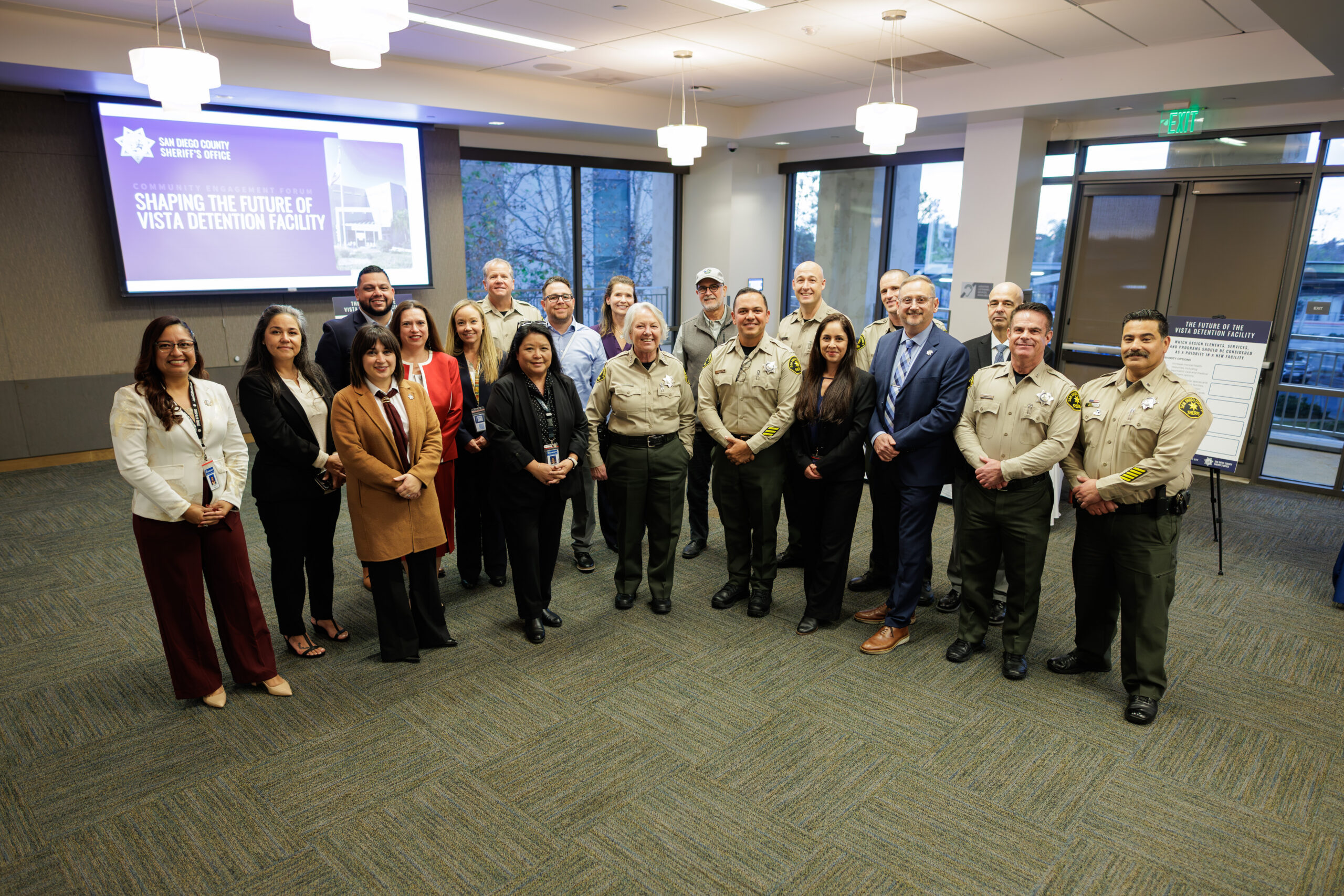
San Diego County Sheriff Kelly Martinez (center) and representatives involved with the Vista Detention Facility rebuild held a public workshop about the project on Feb. 17. | Photo Credit (all): San Diego County Sheriff’s Office
By Charlie Lange
As the San Diego County Sheriff’s Office prepares to rebuild its Vista Detention Facility — the oldest of the county’s seven jails — the project scope covers far more than just building and infrastructure modifications, including intentionally conceived transformations of programs and spaces that the county hopes will contribute to a systemwide culture change.
An article from the September/October 2025 Maintenance & Operations edition of Correctional News covered the county’s holistic approach to the master planning process, which involves balancing immediate and long-term needs, addressing security and staffing concerns and investing in new technologies that will enhance operations inside and aid reentry efforts for those exiting.
Last month, as part of its efforts to engage the local community in the rebuild, the county held an open workshop featuring presentations from a variety of project representatives and question-and-answer sessions with the public. Correctional News spoke with San Diego County Sheriff Kelly Martinez to hear about the feedback the county received, and how those important viewpoints will influence the county’s efforts moving forward.
CN: What were some of the most common questions or themes you heard from the public during the workshop, and how did you address them?
Martinez: The public had questions about why a jail replacement is needed, and also wanted to know if we are going to also address “culture” in the jail that leads to lack of care, medical treatment and in-custody deaths.
We had multiple ways of addressing these questions. They included a video explaining the need for a new jail, centered on a lack of current spaces for treatment and rehabilitation efforts, as well as a jail that no longer meets our values as a society. We also showed two individuals with lived experience who successfully graduated from our medication-assisted treatment (MAT) module and reentry and are now successful in society. We led a guided panel discussion with another person with lived experience, a mental health clinician and a nurse working in the jail, a lieutenant who worked in the jail at all ranks, and finally a local chief of police who spoke to the need for a jail in that region of the county.
We ended the night with various “stations,” where attendees could learn more about the building process, facilities, reentry services and healthcare, and submit their own comments about the process.
Overall, the common themes included a strong interest in investing in programs that help with rehabilitation and mental health, creating space for programs that would benefit educational and recreational opportunities, and keeping communities safe.
CN: Can you comment about the importance of transparency during this process?

Martinez: We have experienced high levels of mistrust in our community related to our jails. This comes from a culture in our agency where we didn’t answer questions regarding jail deaths, we didn’t allow the media in, and we didn’t talk to advocacy groups. As a result, the state legislature had to impose a state audit of our facilities and health care delivery and legislated bills forcing us to be more transparent.
In my administration, I have made it a priority to be more forthcoming on all those fronts. As a leap of faith, we brought the media in and allowed them unrestricted access to taking photos, answered their questions, and included monthly meetings with community critics and advocates.
Transparency is a key driver in our advocacy efforts. When we look at a forward-thinking facility that can provide reentry and rehabilitative services, there is a vast list of stakeholders involved. Our efforts are trying to inspire forward-thinking thoughts and approaches that can bring outside perspective woven in the Sheriff’s Office vision.
Ultimately, we are the client of the county’s general services, and we want to make sure our voice threads with that of our external stakeholders — whether it be those who have experienced our facility, services and programming providers, volunteers and family members of those who are incarcerated.
CN: How will this rebuild help make operations more efficient and allow staff to do their jobs better?
Martinez: The current jail was built in the 1970s during a “tough on crime” and “war on drugs” era, where incarceration was intended as punishment with a philosophy of incapacitation. Our current values reflect a need to rehabilitate and return people to the community in the best shape so as not to reoffend.
A new facility will create spaces that are more therapeutic and conducive to better behavior. We can create spaces that are more positive for our employees, and work environments that are safer.
The current jail does not have direct routes to court, or direct lines of sight, the camera systems are poor, the intercom systems don’t work, and the deputy stations have poor visibility into the modules. A new facility will improve all these deficiencies. There are also currently no private therapy environments for mental health staff to do their jobs, or medical rooms for examinations. The entire facility is dysfunctional for our current needs.
CN: Understanding that this is a years-long process, what is currently your top priority for moving the project forward?
Martinez: We’re taking a multipronged approach: securing funding, incorporating community feedback, conducting environmental studies, informing staff and stakeholders, and hiring a design/build team. It’s essential to show our communities that we want to maintain transparency and allow them to join our journey and allowing their voice to be elevated in this process.
A modern reentry facility isn’t about building a bigger jail — it’s about building a smarter system. Our focus is recognizing that individuals will be returning to our neighborhoods; therefore, we want this facility to focus on providing them job skills, mental health and addiction treatment, and the tools to succeed rather than repeating crime.