



How One Family-Owned Correctional Furniture Manufacturer is Helping to Create More Normative Environments
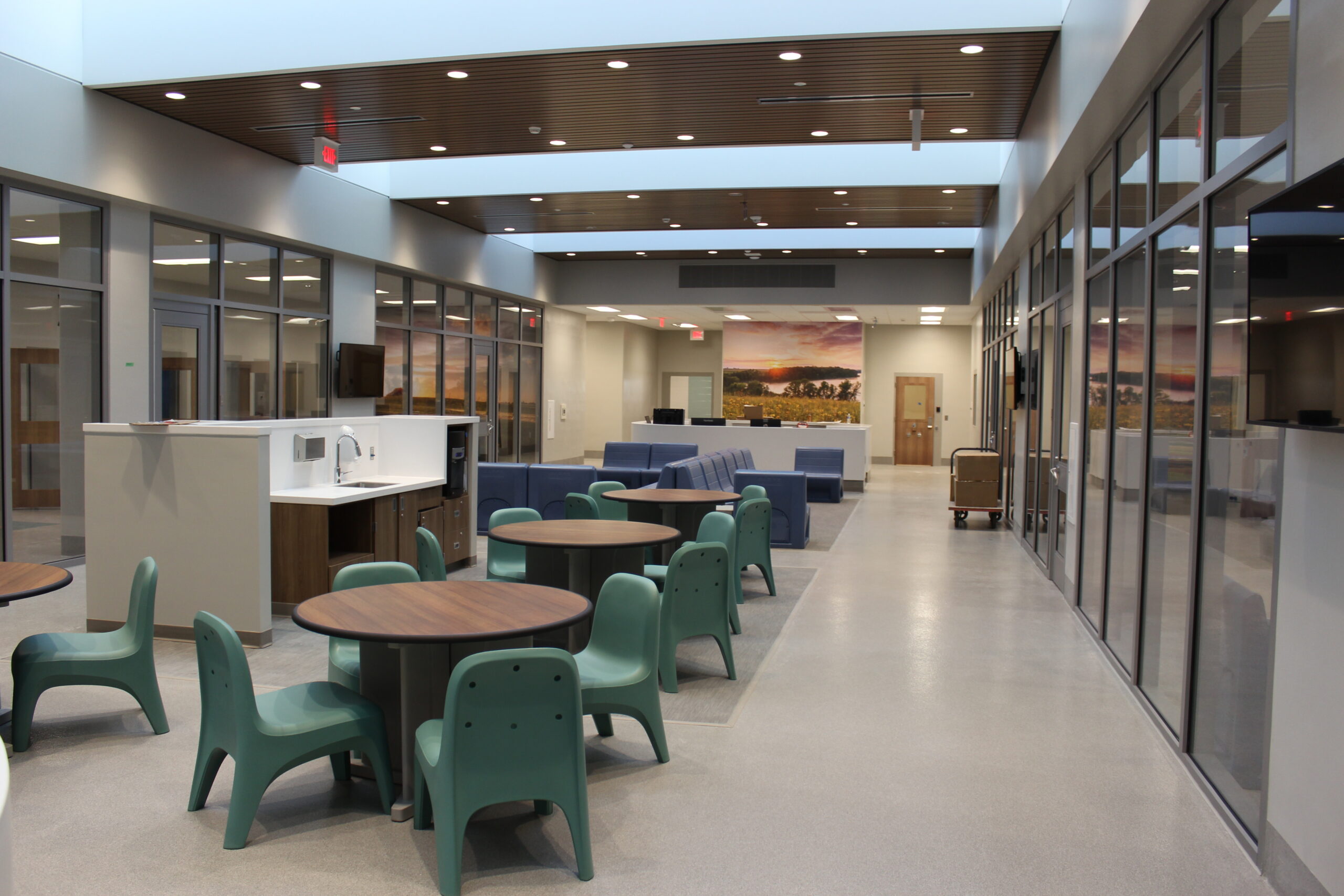
Correctional furniture company Cortech provides a wide variety of products that align mental and behavioral health priorities with security and durability requirements in correctional settings. | Photo Credit (all): Courtesy of Cortech
By Charlie Lange
In an industry that tends to be more reactive than proactive, the ability to foresee emerging trends and plan accordingly can help position correctional product suppliers to solve the most pressing issues for facility owners and operators.
More than a decade ago, Joe Claffy, President and CEO of correctional furnishings company Cortech, and a group of industry stakeholders zeroed in on the burgeoning convergence of behavioral health, mental health and corrections needs from a programming, services and diagnostics standpoint.
“The merging of corrections and behavioral health is upon us, and it’s real,” said Claffy.
As such, shifting from traditional, institutional metal furnishings to softer plastic products built for a normative environment — while still offering the same security and durability properties necessary for correctional settings — would be critical in creating environments that are not only more conducive to rehabilitation for the incarcerated, but are also better workspaces for staff.
Using molded polymer technology and injection, rotational and extrusion molding processes, Cortech manufactures components that reduce noise, feature rounded corners and edges, are ligature-, tamper- and fire-resistant, and provide enhanced maintenance and cleaning benefits. Combined, Claffy says molded plastic furniture and other products can directly improve the very nature of correctional facilities.
“The visual environment forms a lot of dispositions — some towards peace and balance, and some towards anger,” said Claffy. “We can show numerous installations where changing metal to molded plastic has created a calmer environment and produced some incredible outcomes, like decreased inmate-on-inmate and inmate-to-staff violence.”
More than Furnishings
Today, Cortech has grown into a large-scale manufacturing company with products present in facilities in all 50 U.S. states, as well as almost 20 countries abroad. Headquartered in Illinois, with manufacturing partner operations in Wisconsin and Michigan, all products are American made across more than 400,000 square feet of combined production space.
Recognizing that most correctional operators’ needs can’t wait, Claffy says the company stocks seven figures worth of inventory on-hand at all times and strives to ensure a maximum delivery time of four-to-six weeks.
With a product line that started primarily as common area furnishings such as colorful and stackable seating and game top tables, Cortech now offers over 150 products purpose-made for correctional settings, including food trays and insulated delivery carts, tamper-safe waste containers, corner guards, laundry bins and other offerings.
Claffy estimates that roughly 30% of the company’s product development process stems directly from opportunities identified by end users within department and facility operators. The rest, Claffy says, comes from the company’s more than 150 years of combined correctional industry experience, and presence in more than 500 jails and prisons.
“Our product development is never ending,” said Claffy. “We’re always looking for a new challenge, and it starts with anything that’s metal, we feel that we can do a better job making it out of molded plastic.”
Field-Proven Results
Cortech’s commitment to establishing normative correctional environments isn’t just theoretical — it’s evident through more than 2,800 successful field installations in correctional settings, as well as over 1,000 behavioral health-specific installations.
One of the most notable endeavors Claffy highlights was a recent replacement of every piece of steel furniture in each day room within the California Department of Rehabilitation and Corrections’ (CDRC’s) 35 facilities. Fulfilled in just under 11 months, Claffy says the Cortech team developed all custom colors for CDRC, and met every scheduled delivery date during the replacement efforts. According to Claffy, the switch has gone virtually problem-free, with no maintenance or warranty issues reported to date.
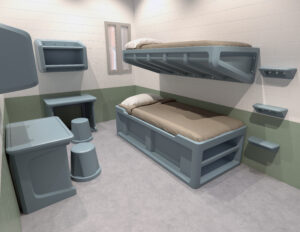
Claffy also says some new facilities are being built with 100% normative features, including not only molded furnishing for day rooms, educational spaces and other common areas, but also within each cell.
Claffy notes that this push for normative cells is one of the most significant shifts he’s seen in recent years. This trend is crucial to bettering outcomes, he says, as it eliminates the clash that having molded plastic fixtures in some spaces and hard steel products in others can elicit.
“It wasn’t that hard to transition the high-supervision common areas into things that are easier on the eyes,” said Claffy. “But now the move is to all-molded-furniture cell, meaning bunks, desks, shelving and property storage, and chairs and stools. The only things left that are steel in the cell are the windows and the toilets — and we might be making those next.”