





Progress Shaped by Perspective: Randall Liberty Reflects on a Career of Correctional Change
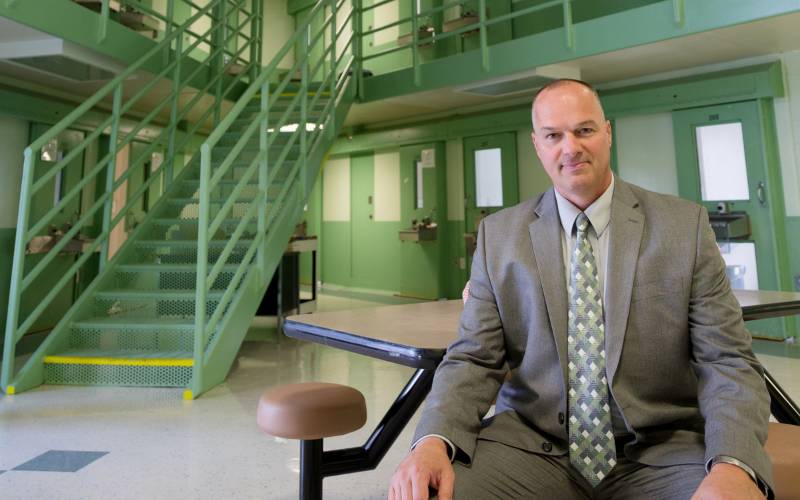
Maine Department of Corrections Commissioner Randall Liberty, who will retire on Oct. 1, helped implement the human-centered Maine Model during his leadership of the department. | Photo Credit: Molly Haley
By Charlie Lange
Maine Department of Corrections (MDOC) Commissioner Randall Liberty’s connection to corrections began decades before he ever expected to lead the state’s system.
Liberty grew up with a deep understanding that “incarceration is a family affair,” as he puts it. His first trip to the Maine State Prison (MSP) came in 1971, visiting his father, who was serving a sentence for a series of burglaries. Raised with three brothers by a single mother and experiencing poverty and food insecurity, Liberty credits teachers and coaches with providing important guidance during his formative years.
After following his older brother into the armed services after high school, broadening his horizons through overseas deployments and benefitting from the structure and discipline from his sergeants, Liberty returned to Maine to pursue a career in law enforcement. His first assignment brought him back to MSP — this time guarding the very unit where his father was incarcerated.
With little on-the-job training, Liberty often turned to his father for insight into the prison’s procedures and politics.
“It would be time for count, and I would ask my father, ‘What do I do now?’” Liberty said. “He was literally my field training officer.”
Liberty later joined the Kennebec County Sheriff’s Department, holding positions ranging from canine handler and rescue diver to staff sergeant, major and eventually serving as sheriff for nine years. While there, he drew on his own military experience to create a veterans’ pod connecting incarcerated veterans with VA and community resources.
Throughout those roles, Liberty said he developed a deeper understanding of the factors contributing to incarceration.
“I understood that mental health, substance use disorder, poverty, neglect, trauma, learning disabilities — that really is who makes up the incarcerated in America,” Liberty said.
Developing the Maine Model
Liberty brought that understanding with him when took leadership of MSP as Warden in 2015, inheriting a traditional corrections environment marked by extensive violence, suicide attempts, 23-hours-a-day segregation in cells and adversarial relationships between staff and the incarcerated population.
When he was appointed Commissioner in 2019, Liberty sought to change that dynamic through a more human-centered approach emphasizing mutual respect, rehabilitation and community reintegration. That philosophy became the foundation of the Maine Model of corrections.
“People aren’t here for punishment. They are here to be rehabilitated,” Liberty said. “Your job is to be a coach, a mentor, a person that’s a role model.”
Liberty’s personal interests and experience influenced the program’s development. A master gardener and beekeeper, Liberty leased 40 acres of land outside MSP and helped establish gardening and beekeeping programs. Those programs provide valuable outdoor time for residents while producing an average of 50,000 pounds of food annually for communities experiencing food insecurity.
Other hallmarks of the Maine Model include dedicated substance-use treatment available to all residents, targeted educational and vocational opportunities, and expanded internet access to keep residents connected to the outside world.
That connectivity has also enabled one of the more unique aspects of the Maine Model: remote working opportunities in which residents can earn salaries from $50,000 to upwards of six figures annually. Portions of those earnings go toward room and board, child support, mortgages and restitution to victims. Liberty sees the remote-work program not only creating taxpayer savings, but also helping make victims of crime whole while breaking generational cycles of poverty and incarceration.
Education as a Path Forward
Education has been another major focus of Liberty’s tenure. Under his guidance, the MDOC college population has grown from roughly 20 students to 170 undergraduates, 12 graduate students and four Ph.D. candidates.
Liberty, who teaches at the University of Maine at Augusta, also seeks to connect incarcerated students learning remotely with those in his classroom. Students visit MSP for restorative circles each term, providing opportunities for interaction and understanding between the two groups.
For Liberty, the emphasis on education is personal.
“My father got his GED at Maine State Prison. My mother dropped out in eighth grade. My brothers and I graduating from college changed everything,” Liberty said. “My children will never experience the things that we endured because of education.”
He sees that same potential at prison graduation ceremonies.
“When I see the residents do that — make their parents proud, make their children proud — their success is guaranteed,” he said. “That is transformational.”
Liberty has also expanded professional development for correctional staff. He created the Maine State Prison Leadership Academy and a professional certificate program available to employees at all experience levels. That effort evolved into the 21st Century Leadership Academy, which includes the Struggle Well program to help officers manage occupational stress, strengthen communication and improve work-life balance.
Building on the Progress
Liberty points to several measures of progress during his tenure. He said MDOC’s recidivism rate has fallen 15% to 21% since implementation of the Maine Model. He also cited a 0.5% return-to-custody rate among residents who earn college degrees while incarcerated — meaning a more than 99% success rate.
As his Oct. 1 retirement approaches, Liberty sees opportunities to continue that work. His priorities for the department include increasing out-of-cell time, expanding restorative practices and staff development, and growing college enrollment to 250 students. He also hopes MDOC will continue developing resources that make corrections a more sustainable career for staff.
His advice to other correctional leaders is simple: “Be bold.”
Liberty encourages agencies to experiment with programs that might begin on a small scale, but lead to big results, pointing to other Maine initiatives such as dog training programs and Pathfinders, an experiential program that brings staff and residents together for hiking, fishing and other outdoor excursions.
“Even if you start a program that’s small and piloted in one unit … very quickly, you’ll see levels of violence go down. You’ll see lower suicide rates. You’ll see all those positive outcomes,” said Liberty.
“The data will prove it, and I think you’ll find it will become contagious.”