




Healthcare Market Provides Critical Correctional Design Interventions
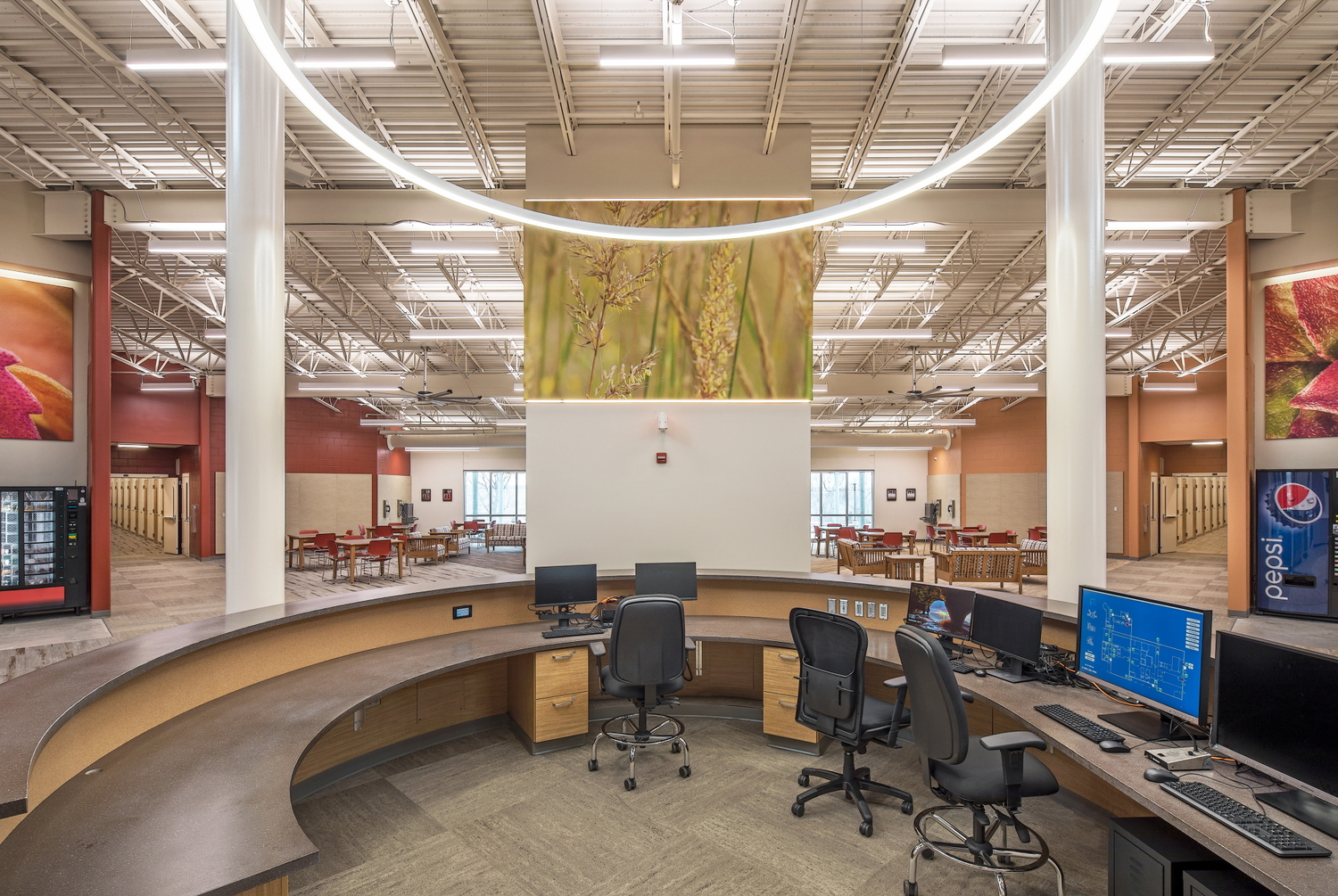
Inmate spaces at the State of Nebraska Women’s Community Corrections Center receive natural light. | Photo Credit: Tom Kessler, Courtesy of Dewberry
By Rosalie Howell, AIA, and Cassandra (Cassey) Franco, AIA, LEED AP
Healthcare, behavioral health and carceral environments are intimately connected in both historical and legal contexts, and when one industry experiences a major shift, it inevitably ripples across the others. The Supreme Court’s landmark 1975 decision in O’Connor v. Donaldson helped catalyze deinstitutionalization and the closure of U.S. asylums, which had indefinitely confined thousands of patients with little hope of returning to society.
Although the decision spurred positive changes in mental health treatment facilities, it also complicated mass incarceration. Correctional facilities now serve a growing population of mental health patients, requiring more staff with better training.
Considering this along with other historical and legislative factors, the intersection between healthcare, behavioral health and correctional environments has been increasingly established over many decades. Unsurprisingly, the industries share goals and challenges: promoting recovery and restoration while struggling to attract and retain staff.
Although many correctional facilities continue to adopt healthcare design and operational elements, there are still underexplored and highly beneficial design interventions that should be incorporated into correctional environments to improve safety, wellness and restorative outcomes.
Attracting and Retaining Staff
A building’s function, flow, daylight and acoustics all have an impact on staff satisfaction, and several design interventions can contribute to attracting and retaining staff, including:
- Respite areas strategically located to allow staff to walk away from stressful situations
- Dedicated staff-only work areas
- Staff wellness areas such as breakrooms, workout facilities and outdoor spaces
- Access to daylight and exterior views
However, architectural design alone cannot solve staff shortages. Facilities also need creative ways to deploy limited personnel and safer operational environments that support retention.
For example, bringing routine specialty services — including telemedicine, dialysis, infusion, imaging and physical therapy — into correctional facilities can reduce transports, increase flexibility, create safer treatment areas and keep staff on-site.
Correctional facilities can look to rural hospitals, which rotate specialists such as podiatrists and cardiologists through one clinic on a recurring schedule. Rotational scheduling and expanded telemedicine could similarly provide more correctional medical services on-site.
Incorporating design and operational elements that create a therapeutic environment leads to positive interactions among building occupants. Positive interactions will create a safer environment for staff and lead to decreased turnover.
Promoting Recovery and Restoration
Peer-reviewed research has examined exterior views in behavioral health, secure housing, educational and medical inpatient environments.
Studies of emotional comfort found that spaces without exterior views negatively affected mood, while those with views had positive effects. Other research connected views of nature with faster inpatient recovery and shorter hospital stays, and linked greater access to green views with reduced stress and aggression in behavioral health environments.
One particularly relevant resource is Roger Ulrich’s 2019 Centre for Healthcare Architecture article, “Evidence-Informed Design Recommendations for Juvenile Facilities in Sweden,” which identifies interventions to improve resident restoration, staff well-being and safety. Ulrich states:
“[…] several strong studies [show] that simply viewing nature for a few minutes reduces physiological stress and diminishes anger, anxiety, and other negative emotions.
Although even brief views of nature can foster stress recovery, the potential benefits of window views of trees, grass, and other nature can be greatest — and extend to influences on treatment and health-related outcomes — when persons experience considerable stress and are required to spend long periods in a confined setting. Such situations include confined treatment facilities, prisons, hospitals and certain high-stress work environments.”
Ulrich’s findings suggest that providing incarcerated individuals with access to exterior views cultivates positive behavioral and physical health outcomes and improves interactions with staff. This impact could reduce staff turnover rates and have a positive impact on staff mental health.
Impacting Future Wellness
As we continue to brainstorm ways to address issues such as — but not limited to — overcrowding, lack of mental health treatment and staffing shortages, it is critical that we understand the historical and social contexts of carceral and healthcare environments and move forward with a holistic approach in order to break harmful patterns and prioritize user safety, staff retention, resident restoration and effective preparation for community reentry. More research is needed to examine these possibilities.
Rosalie Howell, AIA, is a Justice Architect at Dewberry.
Cassandra (Cassey) Franco, AIA, LEED AP, is a Senior Healthcare Architect at Dewberry.
This article was originally published in the 2026 Healthcare edition of Correctional News.