



Inspired by NSA Presentation, Indiana Sheriff Institutes Mural Initiative in County Jail
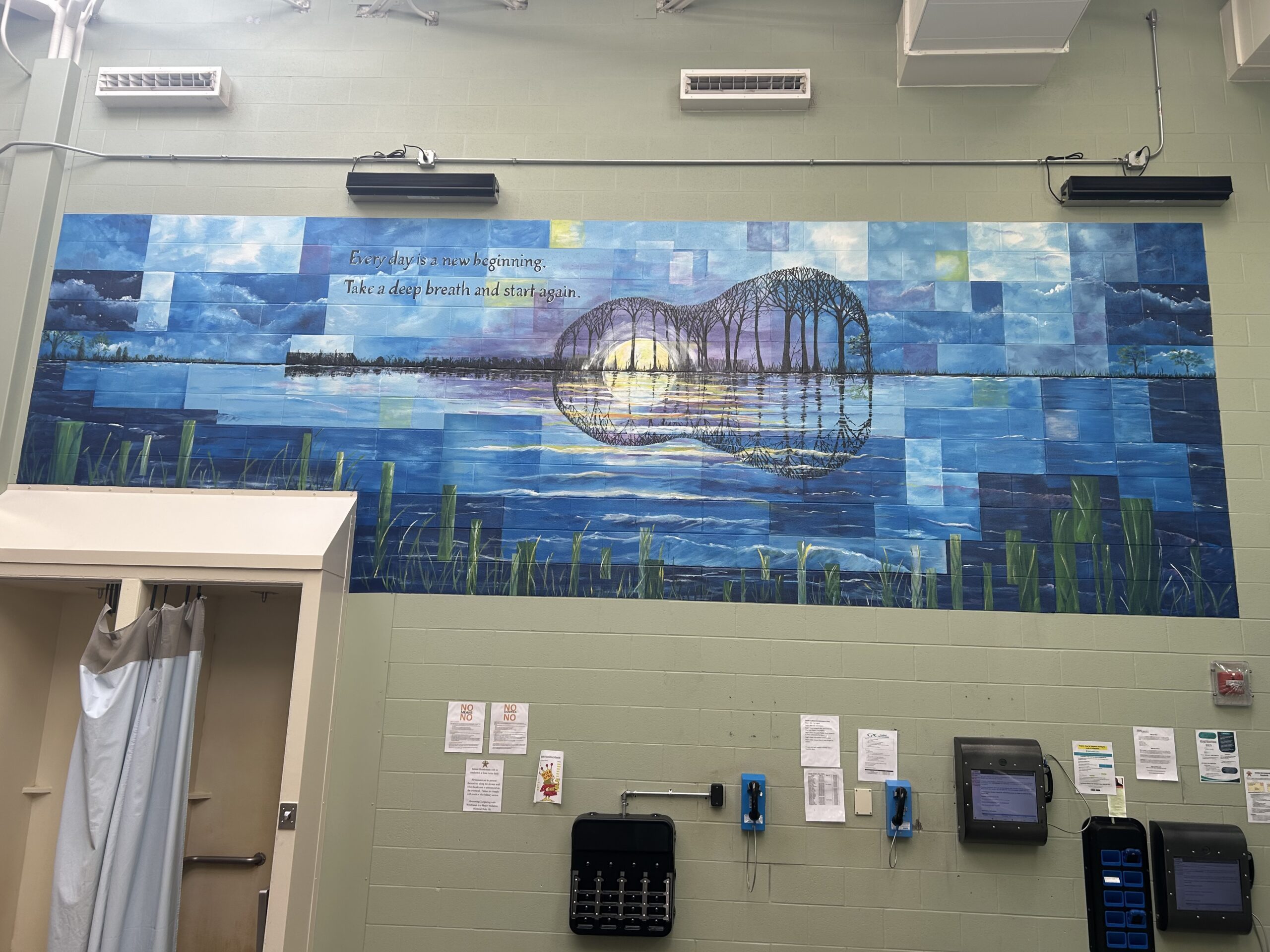
A new mural program inside the Adams County Jail in Indiana has been implemented to contribute to a more positive environment for incarcerated individuals and staff. | Photo Credit: Courtesy of Adams County Sheriff’s Office
By Charlie Lange
Nowadays, most correctional facility owners, operators and designers understand, on some level, how the built environment can affect outcomes. Whether learned through research or from firsthand experience, they have seen how increasing natural light, improving acoustics and introducing a wider palette of colors can help create more positive, rehabilitative environments — and, on the flipside, how monotone cinderblock walls and harsh stainless-steel finishes that have long defined many jails and prisons can contribute in the opposite way.
In Adams County, Ind., Sheriff Dan Mawhorr understands this dynamic. “I know for a fact that the drab color of most jails would ‘get’ to a person after a period of time,” Sheriff Mawhorr told Correctional News.
But after attending a presentation at the National Sheriffs’ Association’s winter conference in Washington, D.C., in January that dove into the psychology driving some of these design theories, Sheriff Mawhorr said the concept further clicked into actionable ideas he could implement in his own facility — the Adams County Jail — to enhance the environment for both the incarcerated population and staff.
In “Behind the Bars: A Psychologist’s Perspective on Designing for Mental Health in Corrections,” Dr. Deanna Dwenger, PsyD, HSPP, Chief Behavioral Health Advisor for Elevatus Architecture, described how safety and security considerations oftentimes strip what she calls “meaningful sensory input” from jail and prison designs, which can leave both staff and those in custody in a constant state of heightened stress or “fight-or-flight” mode.
As a solution, Dr. Dwenger discussed how adding color and other visual elements, such as murals, to interior designs can deepen the connections those in custody feel outside of their immediate spaces within those facilities.
“Thoughtfully designed murals introduce not only color, but also perceived depth, visual variation and even a sense of mental escape,” Dr. Dwenger explained to Correctional News. “When they incorporate elements of nature, they also support biophilic design principles, which are strongly associated with reduced stress, improved mood and better overall behavioral outcomes.”
In the audience, Sheriff Mawhorr took that message to heart, and upon returning to Adams County, he got to work commissioning local artists to come and paint their own murals inside the county jail. The new program kicked off this month with the finishing of the first mural inside the Adams County Jail, according to The Journal Gazette in Fort Wayne.
“What I got out of Dr. Dwenger’s presentation was that color inside of a jail could make a big difference in improving inmates’ and staff’s mental health. She reported that discipline reports go down and the moral of the staff and inmates go up,” said Sheriff Mawhorr. “If doing this will improve the overall health and safety of my facility, why wouldn’t I try it?”
Dr. Dwenger said that research shows that these kinds of modifications offer not just hypothetical, but real-world benefits to safety and overall operations within jails and prisons.
“What we’ve seen in facilities that integrate murals and similar environmental enhancements is encouraging — spaces tend to feel calmer, interactions can become less reactive, and both staff and residents report a more positive atmosphere,” said Dr. Dwenger.
She also pointed out how programs like the Adams County mural initiative can offer both a powerful and a practical way to enhance environments.
“Importantly, these changes can be achieved at relatively low cost while still supporting core goals of safety and security,” said Dr. Dwenger. “There has been a strong interest from sheriffs in identifying practical, budget-conscious strategies like this that can improve daily conditions without requiring major capital investment.”
For Sheriff Mawhorr, that low-risk, potentially high-reward proposition convinced him to bring the mural program to his own jail. His office already received a $2,500 grant from the Adams County Community Foundation to fund the first mural, which was painted by local artist Darlene Vassil.
While Sheriff Mawhorr acknowledges that it’s too early to attribute any quantifiable results, such as a decrease in the number of incidents, to the new Adams County mural program, the initial responses have been in line with those that Dr. Dwenger pointed to in her presentation.
“I was in the pod yesterday and the inmates stated very positive remarks towards the mural. They like the colors and said [the murals] gave them some hope towards their future,” said Sheriff Mawhorr.
“[It is] so much better that looking at a plain pale green wall,” he added.
Sheriff Mawhorr says that his department is looking to spread the word about those positive reactions to local non-profits and other potential funding sources to raise the money needed to expand the program. He has already initiated conversations with other groups to raise $5,000 for the next two murals, which he said will require about 60 hours of an artist’s work to complete.
Overall, he’s eager to see the benefits this program could bring to his facility as it expands.
“I am hoping that as this project progresses that we as staff will start to see the full effects and benefits of this,” he said. “I am excited to start this project — I truly believe it will make a difference inside the jail.”