



Body-Worn Cameras in Correctional Facilities Are Expanding Evidence Collection and Operational Uses
The Arizona Department of Corrections, Rehabilitation & Reentry worked in partnership with Axon in deploying 1,330 body-worn cameras across its prison facilities in 2025. Photo Credit (all): Courtesy of Axon
By Dena Sattler
Body-worn cameras in correctional facilities are doing the critical work of collecting high-quality video and audio evidence — and much more.
With a boost from artificial intelligence (AI), body cameras are helping process video, perform numerous administrative tasks, and enhance safety and security in a more intelligent and proactive way.
As the leading manufacturer of body-worn cameras for law enforcement and correctional facilities, Axon Enterprise is at the forefront of a strategic shift from paper-based records to a streamlined and intelligent system of cameras, cloud-based evidence management and AI-driven incident reporting.
Axon Sales Director for Corrections Zach Austin said the use of digital evidence is rising sharply in part because it promises a more modern and efficient documentation process.
“Agencies have an explosion of digital evidence, and the biggest message we got from corrections agencies and law enforcement as well is they need better tools to manage this large body of evidence and then allow it to flow through the standard processes that they have today,” Austin said.
By automatically storing digital evidence from body and fixed cameras in the cloud at Evidence.com, agencies also can move on from older, on-premise servers with a limited useful life and susceptibility to damage such as fires or flooding.
Austin said more than 20 state departments of corrections use Axon body-worn cameras and roughly 15 have deployed TASER devices.
AI: A Game Changer
Axon’s Draft One streamlines a process flowing from initial evidence capture on the body-worn camera to an AI-assisted draft of reports. As AI helps draft the initial narratives, staff members are freed to handle other tasks such as walking the halls of a facility, building stronger relationships with inmates and other safety-minded duties.
Axon is also developing customized workflows for specific investigation or document flows an agency may need, Austin said, with the process capable of providing tailored assistance in situations ranging from TASER energy device deployment to allegations of excessive force by an inmate and many other situations that demand precise evidence sharing and reporting.
“On top of that body of visual evidence, we’ve built all sorts of tools designed for some of the routine forms that agencies have to fill out,” Austin said. “They could have hundreds of reports that are routine or incident-based,” including such standard reports as inmate count.”
In every situation, accountability and transparency are essential in the process, Austin said.
“I think most importantly in this is that there is an evidentiary record of where those investigations are flowing,” Austin said, adding that AI only “assists” with the draft. A front-line officer and/or someone on the command staff must review that draft, make changes and digitally certify the report to ensure the final product is accurate. Being able to see who has digitally signed off on the investigation document and other details ensures accountability, with customized form flows that know exactly who should review next.
“Leadership has visibility of each step in the process,” Austin said. “It could be as granular as a single investigation, or it could be as high level as everything that is going on in the state department of corrections.”
Arizona Embraces Body Cameras
The Arizona Department of Corrections, Rehabilitation & Reentry (ADCRR) worked in partnership with Axon in deploying 1,330 body-worn cameras across its prison facilities in 2025.
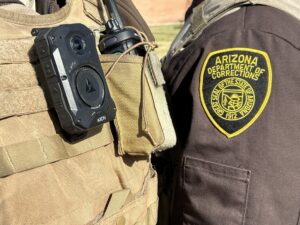
Chris Jackson, Deputy Chief of Emergency Management for ADCRR, designed and implemented deployment of the cameras across nine facilities in the ACDRR system, which, as of February, housed 34,720 inmates statewide.
Most of the ADCRR body-worn cameras are in high-security areas where fixed cameras can’t capture all angles. In those units, every officer wears a body camera, with about one-third of officers equipped with the cameras at Arizona state prisons overall.
As ADCRR works toward a more efficient and streamlined process from video capture to AI-assisted report writing with Draft One, the department is already seeing efficiencies as body-worn camera use eliminates the need to tie up a staff member assigned to gather video evidence manually.
In addition to efficiency improvements, the adoption of body-worn cameras has also led to measurable results in safety and security. From the body camera deployment in May 2025 to February 2026, ADCRR saw a 20% decrease in the time to resolve major disciplinary violations and a 13% decline in use-of-force incidents where the cameras were deployed.
“Previously, whenever we had incidents that needed to be recorded, regardless of their nature, we would have to have staff that go in with a hand-held camera much like you would shoot with home videos in the late ’90s and early 2000s,” Jackson said. “The officer really could do nothing other than hold the video camera and make sure that they’re capturing as much of the event as possible and in a good, clear format.”
Fixed cameras also continue to play a critical role for agencies. Arizona has just fewer than 5,700 fixed cameras of varying age throughout the ADCRR facilities that give authorities still more video evidence from various angles.
They’re using Axon’s Fusus, a real-time, map-based interface that improves situational awareness and response times by seamlessly consolidating video streams from fixed and mobile (body-worn) cameras.
“I can pull up the fixed cameras that I normally have, but I can now also have the body cameras displaying on the same screen and get multiple views of the same incident as it’s occurring live,” Jackson said.
Addressing Officers’ Concerns
When it comes to putting body-worn cameras in the field, Jackson stressed the importance of communicating the positives for corrections officers who regularly encounter serious incidents.
“Just like a lot of things, they’re going to have the concern of, ‘Is this going to be used punitively against us?’ But it isn’t Big Brother watching and micromanaging the actions of our staff,” Jackson said.
Instead, the message is how body-worn cameras serve as a support tool that helps streamline evidence gathering while also giving correctional officers more flexibility in addressing situations that arise — and, mostly importantly, creating a safer environment for staff and inmates alike.
Thanks to the two-way communication capability of body cameras, other staff can see what’s going on, talk to those officers as needed and provide support remotely or directly.
“While they have their body camera recording, they can still actively participate in resolving the incident,” Jackson said.
To read more about how technology providers are enabling safer and more efficient operations for corrections and law enforcement professionals, check out the rest of the 2026 Public Safety & Detention edition of Correctional News.