




Recidivism Reduction Campus Project Seeks to Repurpose Former Prison
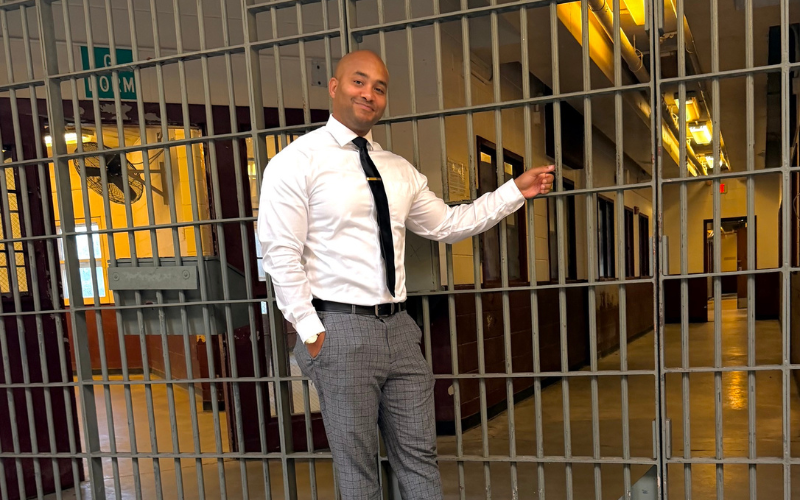
Kerwin Pittman, a formerly incarcerated individual, is leading the renovation of a closed correctional facility into a new campus-style reentry services center. | Photo Credit (all): Courtesy of Recidivism Reduction Educational Program Services, Inc.
By Charlie Lange
Typically, when correctional facilities reach the end of their useful lifecycle, or are rendered obsolete by modern replacement facilities, the buildings are demolished and their sites are redeveloped for new purposes. In other cases, political gridlock or delayed decision-making processes can simply leave the buildings to sit unoccupied.
However, one formerly incarcerated individual is leading an ambitious undertaking in transforming a shuttered state prison in rural North Carolina into a first-of-its-kind reentry facility.
Kerwin Pittman, Founder and Executive Director of Recidivism Reduction Educational Program Services (RREPS), recently purchased the Wayne Correctional Center near Goldsboro, N.C., which has been closed since 2013, and is initiating a renovation across the 19-acre facility to provide transitional housing and support services for those recently released from prison.
The Recidivism Reduction Campus will offer workforce development and job placement, education and vocational training, mental health support, case management and other critical services to individuals reentering their communities. Pittman also hopes to include space on campus for justice-involved youth to participate in career pathways, art and cognitive behavioral therapy, STEM education, and other social and emotional learning opportunities.
Pittman, who spent eleven-and-a-half years incarcerated himself, has used that lived experience to guide his vision for the repurposed facility.
“As someone who did a substantial amount of time, repurposing that space is something people in prison always think about,” said Pittman. “When you’ve spent so much time in that type of facility, you start wondering, ‘What can this space be used for besides punishment?’”
The facility and programming will be centered on a hybrid model, with up to 250 beds to house participants on-campus during a transitional period, while others from local communities will come into the facility and partake in daily programming.

Working with partners in the community will be critical to the success of the project. Pittman is working with local community colleges on programming and instruction, and already has a partnership with one established. His goal is to create a resource model built for the current day, with virtual education modules and other technological offerings.
While complete plans for the Recidivism Reduction Campus are still under development, Pittman envisions the final result being “a mix between an upscale Beverly Hills treatment center and a traditional college campus.”
The first step in transforming the facility will be taking down fences and barbed wire and replacing them with gates that are similar to those that might be found in a university environment. Inside the buildings, Pittman hopes to add therapeutic features such as daylighting, calming paint and color schemes, wood paneled walls and other natural materials. He also mentions energy efficiency as a key goal for the project to ensure smooth operation of the facility.
“We’re literally creating this from scratch, and being intentional about every aspect of the campus design,” said Pittman.
Pittman’s acknowledges that certain aspects within the former prison may be triggering to those who were formerly incarcerated, and seeks to shift “what was once a place of despair into a place of hope.”
“It’s important that the design is led by those closest to the pain,” said Pittman, mentioning that he’s sought input from others with lived experience to broaden the perspective and ensure that the design is tailored to more than just one individual.
Pittman says his organization will work with the North Carolina Department of Adult Correction, along with local prison systems in throughout the state, to receive referrals for individuals to be placed on the campus following their release. One of the biggest challenges will be getting local employers to embrace fair chance hiring of individuals with records of incarceration, he says. By working through state and federal programs, Pittman hopes to secure economic opportunities such as tax breaks and bonding to incentivize employers to invest in transitional workforce development.
As for design and construction partners, Pittman says that several architectural firms have reached out to inquire about the project, but that few have a true track record of designing this kind of model of a facility before. He says he and his partners will continue to meet with architects, general contractors, engineers and other potential stakeholders to figure out how to best repurpose the space.
Overall, Pittman says he is hoping to break ground and move the renovation work forward in the fall, if not sooner. He estimates a roughly two-year timeline to get the campus up and running and fully functional, and while he prescribes plenty of work to be done to transform the campus, he also cites the good overall condition of the existing facility as a major benefit to moving forward.
“The facility has great bones,” he said, stressing that the DAC kept up with routine maintenance even after the prison’s closure in case it had to be reused in the future.
“We’re dealing with a blank canvas, so we can dream big and accomplish it,” Pittman said.